
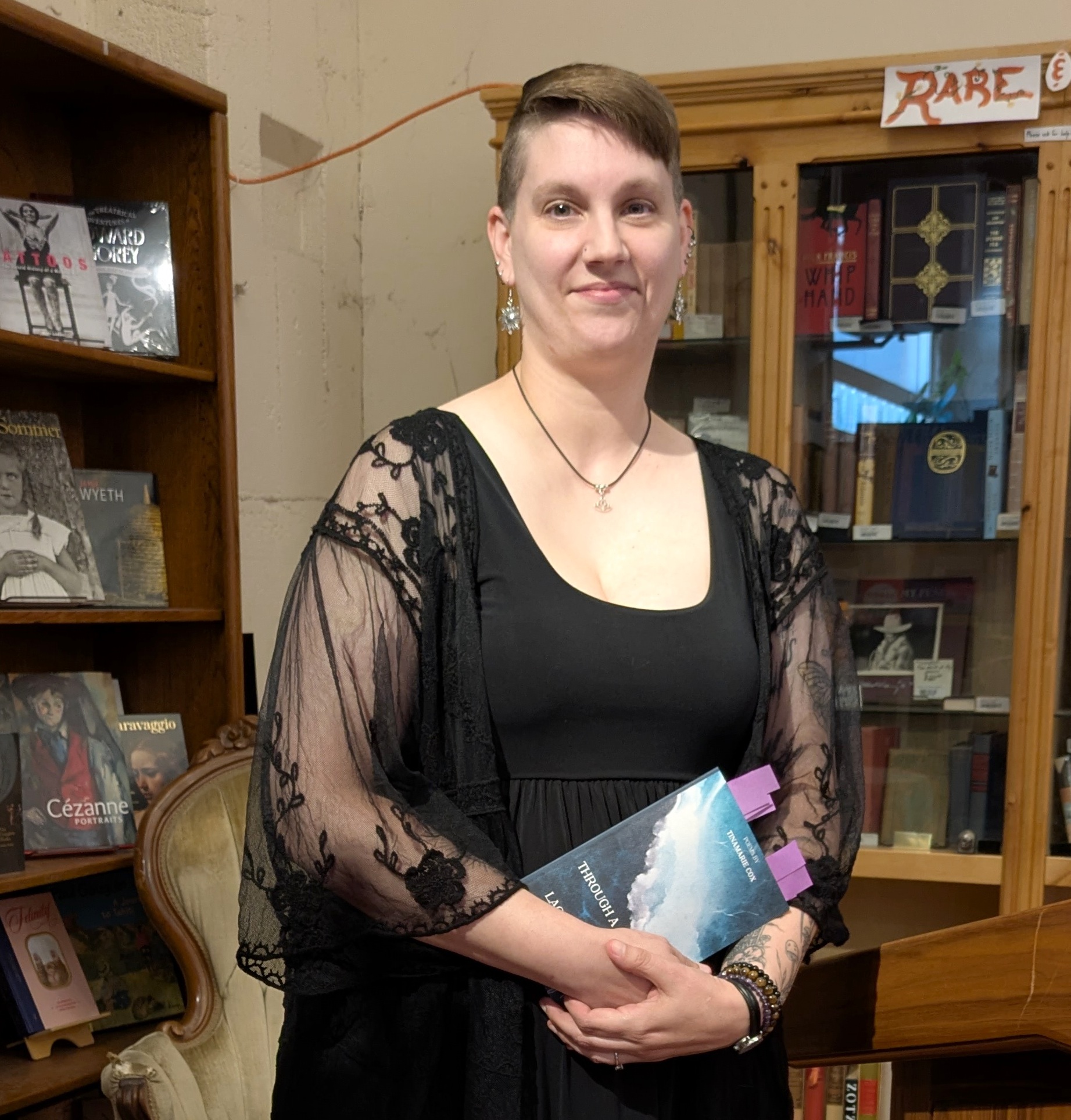
Prescott Valley resident Tinamarie Cox first turned to poetry while journaling about her mental health. “When I began medication and talk therapy, I decided to dedicate more time to poetry, partially as a way to document my journey. I wanted to see my progress. I realized I didn’t have many names for what I felt. However, I had plenty of phrases, metaphors, and comparisons for the emotions I struggled to name. This is where taking up poetry, after a long hiatus, came into play. The therapeutic value of poetry allowed me to examine and explore what I was feeling.”
In that period she published her first book, Through a Sea Laced with Midnight Hues. She says, “As I began to take control of my mental health, I was journaling often and composing poems. Sifting through pieces to submit to publications, I saw the book’s theme appear. By becoming more self-aware and cataloging my emotions, I had unknowingly created the collection.”
Besides writing, Tina produces visual art. “Sometimes I just don’t have words. For those days I paint, mess around with digital images I’ve captured, or craft. Being creative is more of a need than a practice. Something needs to be expressed before I explode. Like taking the whistling kettle off the hot stove. Art projects allow me to feel and experiment in color. They give me a break from thinking.”
Her second poetry collection, A Numbers Game, will be published in March 2026. “Also sprouting from big emotions, this book juxtaposes my history with my present feelings. Heavily probing into my past, I concluded that creating art was just as important for my survival as writing. As the book grew, I selected pieces of art and personal photographs to include with the poetry, spanning from my childhood to my present self. I could look at my first collection as sort of an accident while A Numbers Game was very deliberate.”
Families past and present are great sources of inspiration for Tina’s poems. “My most vulnerable and impressionable years were spent with my family of origin. There are still many emotions from then that I continue to deal with, even as a more well-situated adult. I’ve been putting in the work to unlearn unhealthy patterns so that those dysfunctional cycles don’t get carried into my parenting. My children are my source of inspiration in just about everything. Seeing myself in their eyes motivates me to be a better parent (and human being in general) and to do the hard things past generations avoided. That means making my mental health and emotional wellbeing a priority, which in turn becomes a reason for writing.”
The following poems offer conflicting views on motherhood. “Mothers possess the ability to shape their children’s identities. The first poem focuses on the mother (or gardener) continuing toxic patterns, spreading the poison to the next generation. Mother/Gardener could grow a beautiful family of flowers, but instead, propagates weeds. The second poem is from the point of view of the adult child, realizing that change can (and needs to) begin with her. While the damage has already been done, she chooses not to do the same to her children. This Mother/Gardener understands that she can give her child the things she did not receive but always wanted: empathy, autonomy, individuality, acceptance, compassion, self-expression, understanding, patience, unconditional love, and equality. The greatest gift she can give her child is the ability to bloom into exactly who they were meant to be.”
Tina adds, “I never wrote these two poems intending to create interrelated pieces. But a lot of my earlier work, when put beside my newer pieces, would reflect the growth I experienced both emotionally and mentally over the years.”
Tina views poetry as an ever-changing medium. “Poetry serves many purposes. Through a poem, you can tell a story, recall a memory, make a wish, release your anger, contemplate your existence, vocalize for a cause, wonder about the future, or create something as inspiring as a piece of visual art. I never truly appreciated the versatility of words until I dove into writing poetry.”
More at tinamariethinkstoomuch.weebly.com.
The Gardener Grows Weeds
The seeds were planted into depths
of dark rotted earth,
in carefully measured rows, and watered daily
with the sweetest tasting venom, so
the roots would run deep
through an expanse of pure night,
the spindly veins invading,
amassing into a dense, tangled web.
And there would be no mistake
with what would take hold,
at what would grow,
strong and twisted,
depleting the soil of the garden bed.
Trained, thorned tendrils reached out,
curling fingers grabbing,
searching for a nearby throat.
The weeds crept further,
assailing and crowding out rivals,
each other,
spoiling tender membranes and
choking everything lush and green,
expanding as shadows.
Sour and poisonous botanicals cultivated and
harvested by their bitter queen,
the gardener
who painted her barbed roses black.
A Mother is a Gardener
I dreamed of you.
I dreamed for you.
And in the midst of my thriving garden,
I saw your young vines reaching for the sun;
stretching in all directions, away from me.
I feared and I ached
as the dreams I dreamt faded and crumbled;
as the colors I anticipated changed.
But rather than cut you down;
rather than trim and alter your growth,
I stepped aside to watch.
Something so much more beautiful than
my imaginings appeared, and flourished.
And then, I wished
with silent tears
that my gardener had waited and done the same
for me and my blooms.
My child, you are so lovely
without my shadows around you.
Dee Cohen is a Prescott poet and photographer. deecohen@cox.net.


