
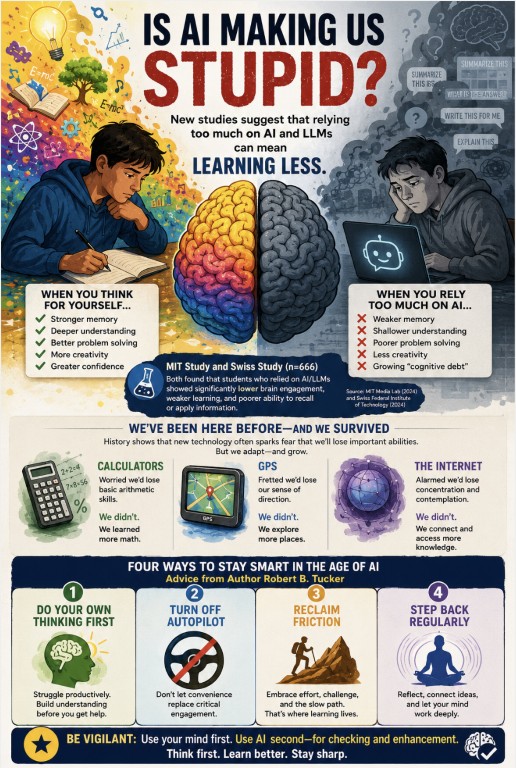
IT’S OFFICIAL: reliance on AI to write and solve problems can be harmful to your reasoning powers. Multiple studies have come to the same conclusions, but the most recent ones released in May and June are even clearer.
The largest study, conducted by the University of Pennsylvania’s Wharton School, involved 4,500 participants who used LLMs and Google Search. The study examined the cognitive differences between two groups and found that people who used chatbots had “shallower knowledge” of what they were asked to research than the Google Search subjects. For instance, when the groups were asked to research how to start a vegetable garden, the AI users gave worse advice in their essays than those who used the search engine. Their depth of knowledge was far lower, too.
Before that study, MIT’s Media Lab studied the impact on 54 subjects aged 18 to 39 in writing SAT essays. Those tested included a ChatGPT-only group, a Google Search group and a group using nothing at all to aid them. MIT used EEG machines to track brain activity in 32 regions while they were writing. Of the three groups, ChatGPT users had the lowest brain activity and consistently “underperformed in neural, linguistic and behavioral levels.” Over the course of several months, ChatGPT users got progressively more lazy in their thinking with each successive essay, many resorting to copying and pasting from ChatGPT answers.
The brain-only group had the highest neural activity, especially in brain regions associated with creativity ideation, memory load and semantic processing. That group was the most engaged and curious. The Google Search group did well, also. When the researchers had those groups use ChatGPT, they had less brain activity and were more likely not to integrate the information into their memories. You can view the results at this link: brainonllm.com.
The Guardian, a British newspaper, published a story with the headline “Are We Living in a Golden Age of Stupidity?” giving insights into the MIT study. It concludes that people instinctively avoid the effort or “friction” that comes with learning, choosing instead to rely on LLMs. This quote from the story sums up the gist of its conclusions:
“We know, from our collective experience, that once you become accustomed to the hyperefficient cybersphere, the friction-filled real world feels harder to deal with. So you avoid phone calls, use self-checkouts, order everything from an app; you reach for your phone to do the maths sum you could do in your head, to check a fact before you have to dredge it up from memory, to input your destination on Google Maps and travel from A to B on autopilot. Maybe you stop reading books because maintaining that kind of focus feels like friction; maybe you dream of owning a self-driving car. Is this the dawn of what the writer and education expert Daisy Christodoulou calls a “stupidogenic society,” a parallel to an obesogenic society in which it’s easy to become stupid because machines can think for you?”
The greatest harm appears to be occurring among the youngest students. Test scores are down across the board, and AI cheating is being called an epidemic among college professors. Policing AI use in writing and requiring more in-class work appears to be the solution to address this problem.
Recently Brown University economics professor Roberto Serrano uncovered mass AI-assisted cheating among his students during a take-home midterm exam. After being suspicious of the unusually high average of 96, he made the final exam in-person. (The previous average was 80.) The results collapsed: the average fell to 48.6, and that was after 18 students who knew about the in-person test dropped the class and another nine skipped the final exam. When Serrano went public with the results, the university gave a “meek” response, while his colleagues and the higher-ed community in general were up in arms and debating how to address mass AI cheating.
Author Robert B. Tucker wrote in Forbes last year about the MIT study and a similar Swiss one with 666 subjects that led to the same results. To avoid becoming too reliant on LLMs to think, he has four recommendations.
1. Do your own thinking first.
2. Turn off autopilot.
3. Reclaim friction.
4. Step back regularly.
Being vigilant about relying on your mind first and LLMs second for checking and enhancement will help avoid the “cognitive debt” of outsourcing too much to chatbots.
As for me, I have never used AI for any kind for writing, because I don’t entirely trust it, nor do I need it to write. But young people who are tempted to outsource their thinking could be at a great disadvantage in the real world when they are forced to think on their feet to solve problems and navigate work environments without the baseline of innate knowledge they’re expected to have already gained.
Journalist Toni Denis is a partner in Seeflection Inc.


