

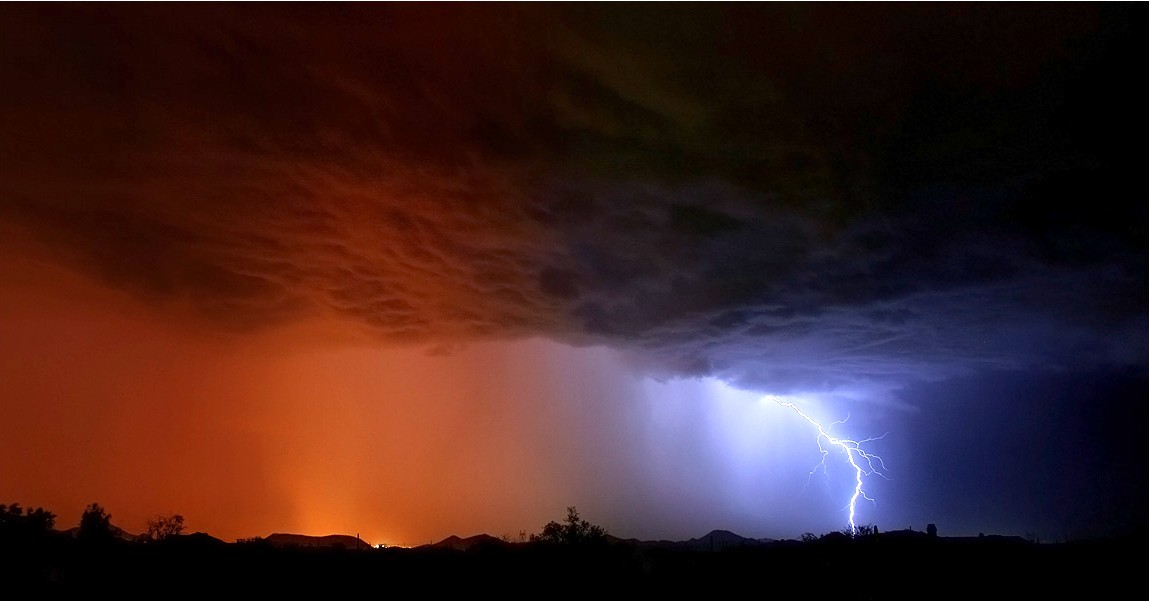
JULY IS STORM SEASON in Arizona. Dark clouds gather over the Bradshaws, lightning flashes across the desert, and astronomers reluctantly cover their telescopes as another monsoon shower rolls through. While thunderstorms rage overhead, another kind of storm is raging 93 million miles away.
On the surface of the sun immense magnetic fields twist and snap. When they do they can unleash solar flares and hurl billions of tons of charged particles into space in events known as coronal mass ejections, or CMEs. Traveling at extraordinary speeds, these solar storms can reach Earth in as little as a few days.
Most pass by unnoticed. Others remind us that space weather is every bit as real as the weather in our own backyards.
In September 1859 British astronomer Richard Carrington was sketching sunspots when he witnessed a sudden flash of light erupt from the Sun. Less than 18 hours later one of the most powerful geomagnetic storms ever recorded struck Earth. Telegraph systems failed, operators received electric shocks, and auroras illuminated skies far beyond their usual northern range. Today we remember this as the Carrington Event.
Had a storm of similar magnitude occurred in our modern world, satellites, GPS navigation, radio communications and portions of electrical grids could all be affected. Fortunately scientists continuously monitor the sun and provide advance warning of potentially disruptive activity.
The reason solar storms affect us at all lies in Earth’s magnetic field. Generated deep within our planet’s molten core, the magnetosphere acts as an invisible shield, deflecting most of the charged particles streaming outward from the Sun. When particularly strong storms strike, some particles become trapped near the poles, where they collide with atoms high in the atmosphere. The result is one of nature’s most beautiful displays: the aurora.
While residents of Alaska and northern Canada enjoy regular views of the Northern Lights, strong solar storms occasionally push auroral activity much farther south. During recent periods of heightened solar activity observers across much of the US reported seeing faint red and green curtains dancing above the horizon. Even Arizona has occasionally been treated to rare auroral displays.
Fortunately you don’t need a major solar storm to observe space weather. With proper solar filters amateur astronomers can safely observe sunspots crossing the face of the sun. Dedicated hydrogen-alpha telescopes reveal even more, including prominences, filaments and eruptions occurring in real time.
As July’s monsoon clouds build over Arizona, opportunities for nighttime observing may be limited. But those same stormy afternoons offer a reminder that weather is not unique to Earth. Our sun is a dynamic and sometimes violent star, generating storms that can affect planets across the solar system.
The next time thunder rumbles across the desert and lightning streaks through the clouds, remember that another storm may be unfolding far above us, one that began on the surface of a star and traveled millions of miles through space.
Clear skies and happy viewing!
If you would like to learn more about the sky, telescopes, or socialize with other amateur astronomers, visit us at prescottastronomyclub.org or Facebook @PrescottAstronomyClub to find the next star party, Star Talk, or event.
Adam England is the owner of Manzanita Financial and moonlights as an amateur astronomer, writer, and interplanetary conquest consultant. Follow his rants and exploits on Twitter @AZSalesman or at Facebook.com/insuredbyadam.


