
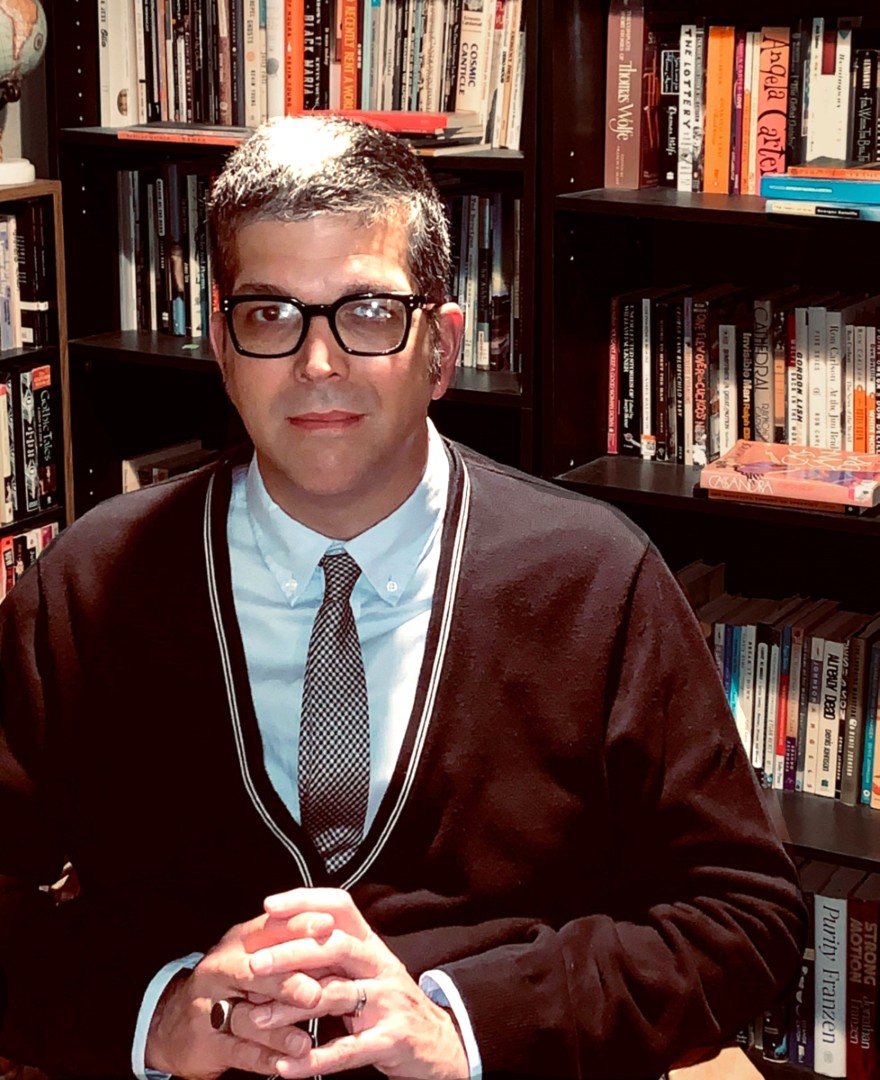
For Tempe poet RS Mengert, poems are a viaduct to the past, a re-envisioning of half-remembered events that still hold great sway. Many of his poems visit and revisit childhood experiences and memories to better comprehend their meaning. “It’s a long way from a nostalgic view of childhood, which for me always seems mostly like a place of fear, danger, ambivalence, with a few brilliant pockets of warmth and brightness. The speaker returns to the origins of his haunting, in which he still feels somewhat trapped.”
Reading Rob’s work is a like remembering the fear of the closet in a dark childhood bedroom. He describes “an absent father figure so mysterious and menacing that he appears almost as a boogeyman, a specter that haunts nightmares and anxious ruinations of insomnia. My mother was caught in the trenches with us, lost and confused, like the child she was trying so desperately to protect.” And those pockets of brightness? His grandparents. “In my poems they appear, often cryptically, as almost shamanic figures, priests, spirit guides, strega as my Italian ancestors might say, and the speaker is left to sort out the haunting in their absence, looking to their memory for guidance.”
Rob has been writing for a long time, but didn’t share his work with others till after he graduated from college. “I continued to write and take workshops to develop my craft, in night classes at ASU and Phoenix College. I had some good teachers in that period who prepared me to eventually attend the MFA program at Syracuse University. All the faculty at Syracuse — Mary Karr, Brooks Haxton, Chris Kennedy, Bruce Smith — were brilliant, and working with them was a life-changing experience. In particular, the late Michael Burkard was my thesis adviser, and he had perhaps the most profound influence on me. He opened me up to creative possibilities that I hadn’t experienced before, and he taught me how to trust my voice and my ear.”
Rob has appeared in many journals, magazines, and anthologies. He has won The Joyce Carol Oates Award for Poetry. His first full-length collection, Hereditary Casino, is coming from Moon Tide Press.
After a stint in Arizona in the early 2000s Rob left and returned for good in 2012 with his wife. “Having originated in Boston, growing up in the LA area and then coming of age in Las Vegas, I’m not sure I’ve ever really felt 100% at home anywhere. Alienation and feeling like a stranger in my own skin are recurring themes in my poems.” In spite of himself he has grown used to living in AZ. “It feels as much like home as anyplace likely will. Other than the heat (seriously, the only place I’ve ever been that’s hotter than Las Vegas), the sprawl and (often) the politics, I can honestly say I like it here.”
Rob has taught creative writing at local colleges. He now works in a public library. “I feel valued and appreciated there, along with a strong sense of accomplishment in the work we do. It makes me feel invested in the community in which I live. And the poetry community here, while small for an area the size of greater Phoenix, is welcoming and earnest without being cliquish. I don’t see us leaving anytime soon.”
The following poem is a profound glimpse into the anxieties and fears of a boy who cannot escape the problems that perennially await him at home. The writer describes the poem as autobiographical “more or less (I am a poet, not a memoirist).” The poet mixes spiritual and existential themes, all seen through the eyes of a child. One is imersed in vivid imagery and symbols: bogs, forbidden fruit, city soot, the unknown wild. The poet describes the child as “an old soul already living on high alert in an environment that is always potentially hazardous.” The “you” in the poem is his grandfather, who “becomes both demiurge/serpent and priest/redeemer.” Rob’s gift for capturing the sound and rhythm of language carry the reader through the poem. He adds, “So much beautiful imagery to work with, but it remains mysterious to me, and sometimes even frightening.”
Marshfield, Massachusetts
Its name was apt. Strewn with bogs
and marshes, fortresses of reeds and cattail,
smell of ocean always just below the heavy air.
You hid me from my father there
while mother plotted our escape out west.
A wooded coppice hedged your neighborhood,
dense with dappled foliage, gold and crimson blaze
that burned away the city’s soot
we carried with us. I was afraid
to venture there alone, but one day
you walked with me, took me by the hand, my Virgil
to that netherworld, and we grappled through the damp
mist-sprinkled thicket that smelled like firewood and God.
You grabbed a branch. You held it down
to show me a cluster of wild berries. I had been told
that wild berries were poison, that one should never touch
the strange, the unknown wild.
But you held the berries in your thick
North-ender’s hands as if they were as safe and ordinary
as the copper wire you had shown me in the basement.
The fruit was blue-black, each berry a tiny cluster
of egg-shaped cells, a honeycomb turned inside out
then smoothed around the edges.
You plucked some free, brushed them off,
and ate them. Not even washed.
Wild berries were poison, and
poison meant death. I had been told.
It was as though you had some secret gnosis,
and could eat God’s fruit unmediated,
and live.
You were immortal, I would die.
You held some out to me to share, but
I knew what I knew.
(Previously published in Italian Americana: Summer/Fall 2020)
Dee Cohen is a Prescott poet and photographer. deecohen@cox.net.


