
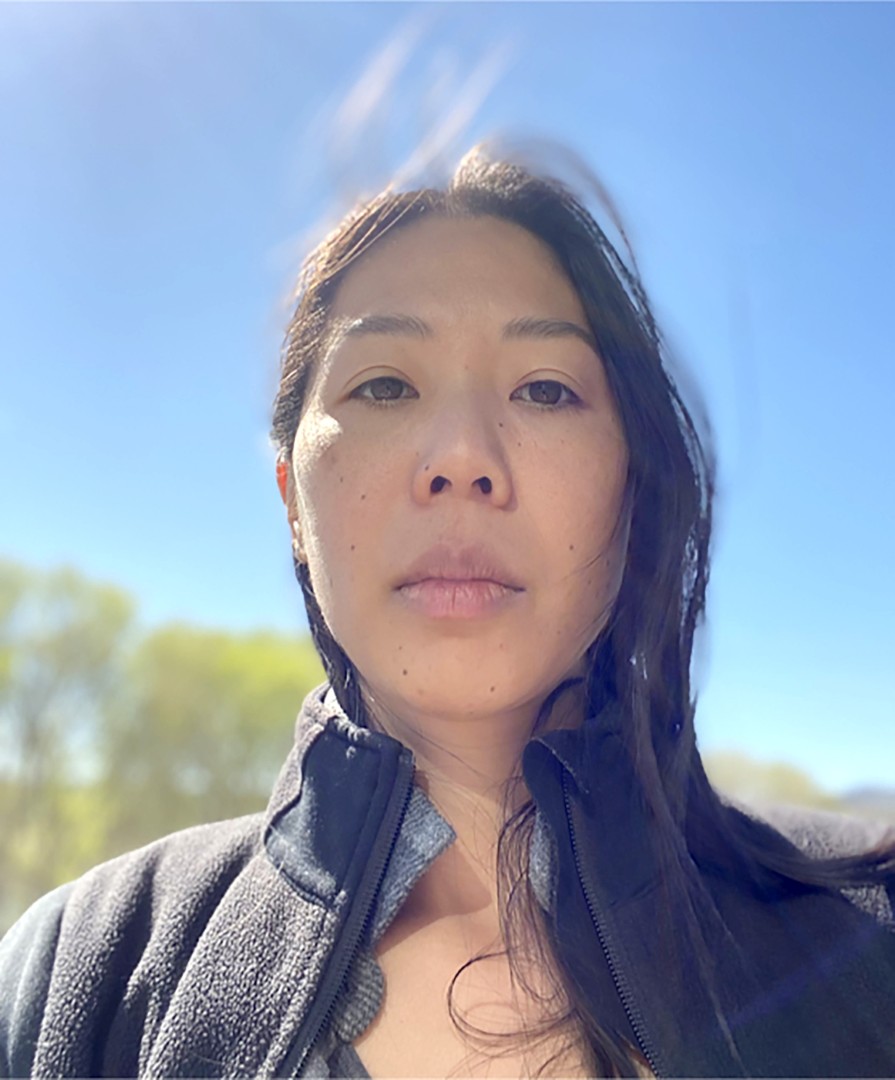
SOMETIMES it’s a long journey back to our beginnings. Poet Dominique Ahkong recalls swimming with her mother in the ocean in Mauritius, the island her parents are from. “When I was a child we’d often swim together, but when the water was too cold for me I’d wrap myself in a towel and watch her from the shore.”
Many years later, after a long period of caring for her mother during chemotherapy, she’d return to the image of her mother swimming and incorporate it into a poem, “Ghazal for Familiar Women.” “I wrote it in the guestroom of my inlaws’ basement in Southern Colorado. I’d been returning to a memory of standing at the hospital pharmacy, waiting to receive my mother’s medication, and noticing women around me who from the back resembled my mother. I knew they were cancer patients partly because of the way they dressed, but it was mainly the appearance of their upper bodies that struck me as familiar.”
A ghazal (pronounced 'gazahl') is an Arabic poetic form made popular by medieval Persian poets. It characteristically consists of complete couplets and an intricate rhyme scheme. Each couplet ends on the same word or phrase (the radif) and is preceded by a rhyming word (the qafia). The last couplet includes a proper name, often the poet’s. Although not quite a true ghazal, Dominique employs many of the distinguishing elements of the form to create a poem whose repetitions capture a haunting sense of regret. “The poem came together very quickly, one week. Five months later, it found a home.” It was also nominated for Best New Poets Anthology.
Dominique is of Hakka-Mauritian descent. She was born in the UK and raised in Singapore. “Like many writers, I was a shy child and an avid reader. I was very much drawn to language, music, and creative expression.” She eventually attended school in the US, majoring in women and gender studies, then focusing on film and visual media. Her love of writing was never far from her mind. “Still poetry found me. One of my favorite classes in my graduate school program was called 2x2 (Creating media for tiny screens). My instructor asked us to create a video or animation set to a poem. I animated Li-Young Lee’s Early in the Morning. I didn’t realize the impact that reading the poem out loud over and over again would have on me. As part of my thesis, I also ended up making a popup book with little poems hidden in pieces of paper furniture.”
Over time, she would make her way back to poetry. “I wrote here and there, got my first poem published at 31. I didn’t establish a real poetry practice until I was 39, during Covid, when I moved to Arizona. My second poem was published exactly ten years after my first. I’m now 43 and have had 21 more poems published in journals, but I’m still writing towards my first collection! A different path for every poet.”
Dominique now resides near Chino Valley with her husband, poet Johnny Cordova. Together they co-edit and publish the renowned Shō Poetry Journal. “Publishing is very time-consuming because I wear many hats, and because the journal is still a toddler, so to speak.” But she also finds it gratifying. “It is a responsibility and a gift. It’s brought me into community with other poets and has been incredibly enriching and expansive for my own poetry practice. I learn from the journals that have supported my own work and I learn from other poets.” Editing has taught her a lot about publishing. “I’m now aware that there’s so much that goes unseen, so I’m more patient and try not to take rejections personally.”
Returning to “Ghazal for Familiar Women,” Dominique explains, “It’s possible to read this poem and say there is little nuance in the speaker’s views on faith — perhaps until the final couplet. I also employed a call to the poet’s proper name that traditionally appears in a ghazal’s last lines. My name, Dominique, means “of the Lord, close to God,” which has always given me pause. But underpinning the ghazal is this sense of longing, an ache, which is expressed through the repetition of the radif: back / back / back. I think that borrowing the rough form of a ghazal helped birth a longing for my own trust in the divine, a way to meet my mother in her faith through a vehicle that is true for me.”
More at dominiqueahkong.com and shopoetryjournal.com.
Ghazal for Familiar Women
In the way we can spot kinfolk from the back
by their gait, these women unknown to me, backs
facing me, feel related. More than the long sleeves
and bucket hats, it’s the eroded downstroke of their backs
that’s vernacular, it’s what they do not do, even while
their eyes are watching God disrobe and back
away. They hold out their veins, unblinking, while black
bags are hung from their necks like ropes. Back-
aches persist but do not fracture their language in this way.
Comfort is a drained infusion pump, three days a foe. Back
at home, as night falls, a husband holds his wife’s hand.
His daughters will rub their mother’s unrobed back
and cover it after her body’s churning. Her
requested balm: atonal invocations back to back.
Will you embody your name, Dominique? See your mother
plunge into the cold ocean, then turn to float on her back.
First published in Sugar House Review Issue 27, Winter 2023
Dee Cohen is a Prescott poet and photographer. deecohen@cox.net.


