
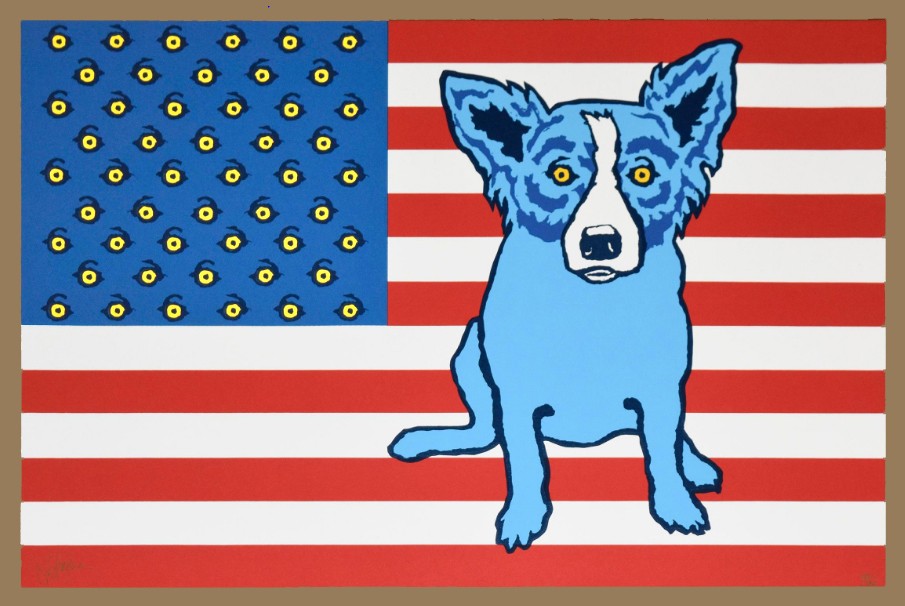
“THREE CHEERS for the red, white and blue!”
Most folks know that refrain, even if they don’t know all the lyrics (or any of the lyrics) to the song “Columbia, the Gem of the Ocean.” Even fewer know the words to the song “Hail, Columbia.” The latter dates from 1798 and was more or less our official national anthem until Congress adopted “The Star-Spangled Banner” in 1931. Yes, that recently. Do an internet search and give “Hail, Columbia” a listen sometime. Pretty dramatic. As far as a national anthem, I prefer “Columbia, the Gem of the Ocean” to either, but anything related to the name “Columbia” went out the window when that part of South America became a country. Not to mention British Columbia, Columbia, South Carolina, and others. So we can’t share the name in an anthem that’s meant to be distinctive.
But we can and do share “the red, white and blue” of our flag — with about thirty other countries. You can sing “three cheers for the red, white and blue!” and be referring to the flag of France, the United Kingdom, Costa Rica, Norway, Panama, or ….
How about North Korea? Maybe Russia? What is it about this color combination that inspires so many national flags? Not only is the color scheme repetitious, it gets confusing after awhile. Cuba’s flag looks a lot like ours. At least the stripes in the French flag are vertical instead of horizontal. But they’re all red, white and blue. Having spent a fair amount of time in the South Pacific, I have a particular soft spot for the Australian version, with its UK flag relegated to the upper left corner and the splash of the stars of the Southern Cross occupying the rest of the rectangle, which stands for the vastness of the Pacific and the sky overhead.
I suppose that from a visual standpoint there might be something uniquely comforting about the color combination. And so many flags are careful to include red. But when everyone’s flag looks like everyone else’s it becomes difficult to stand out. Someone with weak vision might find themselves accidentally saluting the flag of Croatia when they mean to be acknowledging the flag of Cuba. Or our own. The Cuban national anthem, by the way, is a pretty catchy march that sounds like it could have been composed by Sousa.
But if you want to be distinctive, the best route to take is to employ unusual colors. For example, there are only two flags in the world that include the color purple: Nicaragua, which only uses a touch of the color, and Dominica. As if using purple wasn’t enough, the Dominican flag also features a parrot in the middle. Eye-catching. Imagine the US flag with an eagle in the center. Not too shabby a look. Benjamin Franklin would have preferred a turkey (he wanted it to be our national bird. Not everything Franklin proposed was genius).
The flag of Qatar is mostly maroon. Its shape is also unusual, being the only national flag with a width more than twice its height. You can’t mistake it for anyone else’s. Nepal probably wins for distinctiveness. Meaning no disrespect, but its flag looks more like something you’d find at a NASCAR race than fluttering atop a government building. Kudos to the Nepalese for making that visual and aesthetic jump. On the other hand, while the shape may be unusual, the colors are: red, white and blue.
So if there is anything special about the flag of the US, it is not its choice of colors. As an American, I certainly don’t mind sharing the combination of red, white and blue with other countries. Yet our flag does have one specific characteristic that other flags lack.
Ours is infinitely changeable while largely staying the same. Because we add stars.
As territories become states, our flag changes to reflect that. Cuba’s doesn’t. Norway’s doesn’t. Russia currently might like to, but such a prospect isn’t going so well for them. But if Puerto Rico (which has its own flag) someday votes to transition from being a territory to becoming a state, we’ll have to add another star to Old Glory. And rework the geometric pattern therein. Probably have AI do it. Same for American Samoa, and possibly others. Our flag is mutable. Just like our country; something proven over the past 250 years.
Prescott resident Alan Dean Foster is the author of 130 books. Follow him at AlanDeanFoster. com.


