
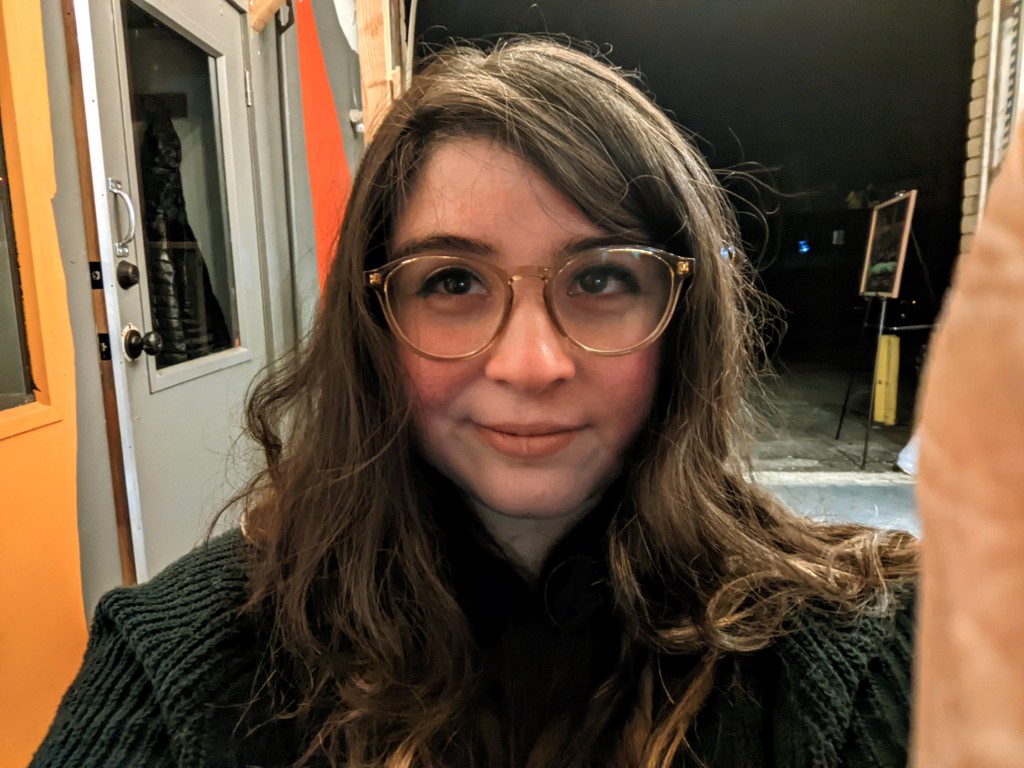
FLAGSTAFF poet Margarita Cruz doesn’t take her friends for granted. “I often credit finding a community of poets in my early twenties as the reason I survived some of the roughest patches of my life. I felt like I had nowhere to go when I found myself adopted into a community of fabulous poets and writers. Suddenly I didn’t feel so alone.” Since then she’s been determined to give back to the people and programs that helped her.
To that end Margarita joined the board of the Northern Arizona Book Festival in 2018, working her way up from secretary to president, and was instrumental in establishing its annual Heritage Square Book Fair and the Flagstaff Youth Poet Laureate position. She looks back with gratitude for her involvement with the festival. “I’m honored to have been surrounded by amazing writers and people, and experience many wonderful workshops and readings. Being behind the scenes of these large productions demonstrated that, while writing itself is important, the community of writers and readers is invaluable.”
She also created Poets Brew, a weekly open mic for writers that has just celebrated its third anniversary. “We regularly see writers from the Williams, Sedona, Prescott and Cottonwood areas, as well as visitors from around Arizona, but we also have a ton of regulars from Flagstaff come out. These writers are at all stages of their writing careers: hobbyists, students, emerging and established writers, we see them all!” Margarita also collaborates with local literary organizations and small presses, and writes articles for Flagstaff papers. “If I can make someone’s voice feel heard, then I’ve done it.” Margarita recently accepted a position in Oregon with the City of Eugene’s performing-arts center. Her many talents and contributions will be missed in Arizona.
Margarita has published many poems, uthored the chapbook Amerixana, and finished work on a new poetry manuscript. “The book examines systems of connection under the auspice of dreaming, from familial disruption impacted by migration and cultural expectations, to mythologized and unknown medical lineages, to the ways landscapes have defined themselves as home for myself and the people before me.”
Poems come to her in various ways and on various time schedules. “I save everything I write, because sometimes I can knock out a poem in a couple of hours, or I can spend upward of three years working toward completing it. A poem might appear at the right time, or it might take time to germinate and reveal itself.” Responding to current events is an important feature of her work. “To be human, to live, to be free, to make art in a country that wants to censor parts of humanity will always be political. It’s one way we can say something to the public, to hopefully change a perspective, and speak about both the horrors and wonders of this world.”
In “I Will Always Hear the Dogs” Margarita reminisces about a time and place of great meaning in her life. “It was centered around this beautiful little purple house, where I lived with a dear poet friend of mine. We were both navigating life — we spent many nights in that house speaking about poetry, making poetry, but also living out moments that were both painful and wonderful. Those days felt so freeing and so unencumbered by the weight of the world. That purple house became a time capsule for discovery and wonder and the pains of early adulthood. In a sense it is an elegy to who I had been.”
For Margarita poetry offers great possibility. “It has the potential to save people, to keep people alive in the darkest of moments, to bring people together, to resurrect the past and future, and to change the world.” A sense of community is always at its heart. “Without community, how else will our little seeds of hope and determination eventually blossom and enact change?”
More at shortendings.com.
I Will Always Hear the Dogs
in a purple house where once I really lived,
I felt the breath of birds chirping outside my bathroom window.
I’d open up the glass in the middle of winter to watch the neighbors,
three dogs barking inside thin metal cages.
Fog in the mirror, chipped away under our thumbs before the spring,
before the bones in the body were chipping away. Here, we spent nights
hung out to dry. Broken glass bottles in the driveway, cigarettes
in early morning fog. All of the ache in my body lives in this house.
If I had known back then that living meant
I’d learn to sing out over the roar of midnight silence, slide
our warm hearts over ice-slick road, dig our hurt into the sides of a broken couch
or breathe into the open window on Christmas morning naked in the shower,
if it meant making midnight phone calls to old lovers and pizza men —
if never living meant I never would have howled into the night, flames in hands,
never watched the stars fall, never wake the neighbors just after Autumn —
watch the summer open our insides out after falling to sleep stirred by the wildest
dreams of dying, of watching my friends find themselves wanting to live
to see the next sunrise and the next and the next,would I crack open that window again to listen to the dogs bark?
Dee Cohen is a Prescott poet and photographer. deecohen@cox.net.


