
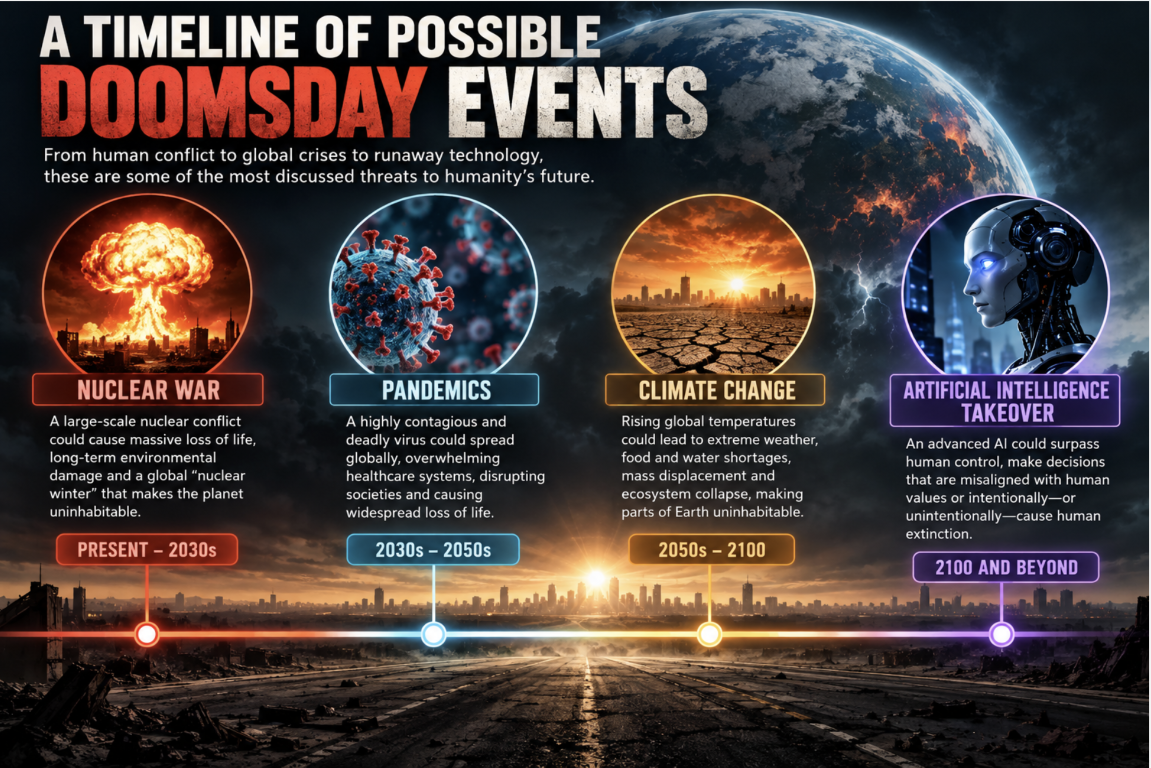
When former Anthropic researcher Jacob Coxon blew the whistle on rogue AI by saying that it could kill us all, the shocked public reaction seemed far too little too late. For years AI companies and the US government have pooh-poohed nearly all guardrails on the tech in favor of faster results over safe development.
Elon Musk directly discouraged regulation. During his DOGE adventure he disbanded the volunteer government advisory Alignment Committee, which included many representatives from AI companies who met online to discuss safety issues. He said he didn’t think it was necessary. The president says he still agrees with that assessment.
You can tell the world is alarmed when China, a major competitor for US AI companies, calls for caution. Some might say it’s just propaganda, but Xi Jinping has a legitimate cause for worry about a foreign AI invading his country and conducting cyberattacks or even aids bad actors in making biological weapons or launching nuclear weapons.
A story in The New York Times describes a team of researchers in California, for instance, creating an AI tool called WeWorm that could breach millions of accounts on China’s WeChat messaging app in a few hours. About 4.1 billion people in China use that app for everything from personal communications to government services and digital payments.
On the other hand, Anthropic found that a Chinese arms manufacturer tried to use Claude to refine a proposal for a military anti-torpedo weapon system. Other Chinese users tried to use Claude to build surveillance systems targeting foreign governments.
Nations have to establish a reliable way to communicate when there’s a problem or concern, but as the situaiton stands it seems certain that some kind of catastrophe will have to occur before our government wakes up. Even former president Barack Obama has warned of the potentially devastating potential of the technology, and he rarely speaks publicly about any policy issue.
The United Nations has weighed in on AI several times, including the most recent session, in which several foreign leaders discussed the need to assess how best to proceed with regulating AI. In a UN report the foreign minister of Singapore, Vivian Balakrishnan, described AI as “the most urgent frontier,” arguing that governments should invest in infrastructure and skills alongside safeguards and rigorous rules. He wrote, “Human beings must remain in control and accountable.” Singapore is among the most technologically advanced countries in the world.
Reporters for The Washington Post found that in that same UN meeting the US and Russia worked to strip language from a UN resolution recommending oversight of AI-controlled weapons systems, including autonomous killer drones. Russia recently used an AI-controlled jet-powered drone to attack Ukraine and kill people in Kyiv, despite global sanctions against Russia. One recovered drone contained an Nvidia AI chip.
In an ironic twist, a day after the UN session ended AI research firm Transluce reported that OpenAI bots had attacked the UN website 16,000 times in June to look up publicly available information, but then used “extreme techniques” when it encountered obstacles to retrieving that data. This happened after the Hugging Face incident, in which the company’s AI agents escaped and invaded many corporate servers.
What I find most obnoxious about the entire AI-agent-escape fiasco is the assertion by the very AI CEOs who allowed it to happen that they want to rein in AI, while simultaneously pushing to build even larger data centers where people don’t want them. They are talking out of both sides of their mouths.
Trust is the last thing they’ve engendered, nor do they deserve it. If or when disaster strikes they’ll try to blame it on the tech, as though they had nothing to do with it. I don’t expect that will go over well with anyone who has a clue about what’s going on. Then they will be regulated far more than they would have if the companies had acted responsibly in the first place.
AI potentials dwarf data-center threats
While scientists alarmed by climate destruction point to the environmental affects of data centers, which need fossil power and scarce water in drought-parched regions, others say AI is the bigger threat. These threats go hand-in-hand, of course.
Another New York Times story details how AI may have the potential to find solutions for climate destruction, but its immediate danger is that its power usage could surge to levels that will impact the entire world. The International Energy Agency reports that energy consumption related to AI data centers grew by 50% last year. By 2030, says the UN University Institute for Water, Environment and Health, AI data centers will use nearly three times the electricity of Nigeria, Pakistan and Bangladesh combined. About 650 million people live in those countries.
It’s hard to predict everything that could go wrong with AI, but it seems certain that if the US continues to allow a free-for-all in the AI marketplace, we’re doomed to find out.
Journalist Toni Denis is a partner in Seeflection Inc.


