
I’m growing vegetables here in Prescott, where we receive about 15 inches of rain in an average year. How would I grow food if six inches can count as a year’s supply? More than 80 people gathered at the Yavapai-Prescott Tribe Community Gathering Center on September 11 to consider that question. “Growing Food in an Arid Land,” the second chapter of Slow Food Prescott’s Hidden Roots, Future Harvests™ food and lecture series, connected the revival of a tribal community garden with generations of Hopi farming knowledge.
A garden comes back to life
Marion Johnston, who is Cherokee, and Violet Mitchell-Enos of the Yavapai-Prescott Indian Tribe began with photographs of the Yavapai-Prescott Indian Community Garden, whic turned an overgrown, unused site into good soil and green raised bedsand growing plants. The garden had come to life.
Marion discussed Cherokee agricultural traditions, including corn, beans and squash grown together as the Three Sisters. Violet shared botanical knowledge passed down to her by her Yavapai elders, who knew which plants to gather, which parts to use and when to harvest them.
Violet also discussed the history of the Yavapai-Prescott reservation and showed images of the wikiups that her people had used in the same area where the garden now sits — a garden that now gives Yavapai-Prescott children a chance to plant vegetables and seeds, placing their hands into the same soil on which their ancestors lived.
The Yavapai-Prescott Indian Tribe Board of Directors provided land, fencing and grounds maintenance. Master Gardeners, Prescott College students and community supporters contributed technical help, labor, seeds and plants.
The garden’s influence now reaches beyond its fence. Marion and Violet described people taking seeds, knowledge and confidence home, establishing more gardens and sharing what they harvest.
As a farmer I find that powerful. The most useful garden is not necessarily the one with the largest harvest. Sometimes it’s the one that makes someone else believe, “I can grow something, too.”
Reading the land at Hopi
Dr. Michael Kotutwa Johnson, a Hopi dryland farmer and University of Arizona professor, then turned to the Hopi landscape. Hopi lands sit on the Colorado Plateau at elevations between 4,500 and 5,500 feet, where precipitation may total only six to ten inches annually.
Johnson explained that Hopi farmers do not treat rainfall as a single number or soil as an interchangeable growing medium. Snowfall matters. The timing of rain matters. Soil texture, slope and topography matter. Farmers manually check soil moisture before planting, then adjust seed depth and spacing according to what they observe.
The Hopi locate small fields where summer monsoons can deliver runoff. Sandy slopes, washes and channels become a water-harvesting system shaped by the land rather than imposed on it, using techniques learned over generations of observation and adjusting.
The engineer in me recognized a sophisticated water-budget system. The farmer in me saw something important: humility. Hopi farmers begin by asking the land how to grow in that place.
Johnson also showed that farming produces more than food. Families work together. Knowledge moves between generations. Harvests reinforce a culture of sharing. He summed it up as, “soil health plus plant health equals human health.”
Food sovereignty and values
Johnson describes Indigenous food sovereignty as the right of Indigenous peoples to continue accessing and using the lands where they forage, farm and hunt. Food sustains physical health, but it also carries cultural identity, ceremony and spiritual beliefs.
Food sovereignty includes control over seeds, agricultural knowledge and data gathered on tribal lands. Who decides how tribal seeds are stored, bred and used? Who should benefit when for-profit companies use indigenous knowledge to develop new seed hybrids and varieties? Who benefits from the profits?
Johnson believes that personal and community values must come before profit. That point landed with me as both an engineer and farmer. We can calculate yield, labor, water and cost, but numbers cannot decide everything. A system can appear efficient while consuming its soil, weakening a community or borrowing too much from the future.
Johnson cited a 2026 analysis finding that 62% of Arizona’s farmers and ranchers are Indians, tending nearly 21 million acres of tribal lands contributing about$753 million to the state economy annually. Indigenous agriculture is not a historical footnote, it is central to Arizona agriculture.
A shared table
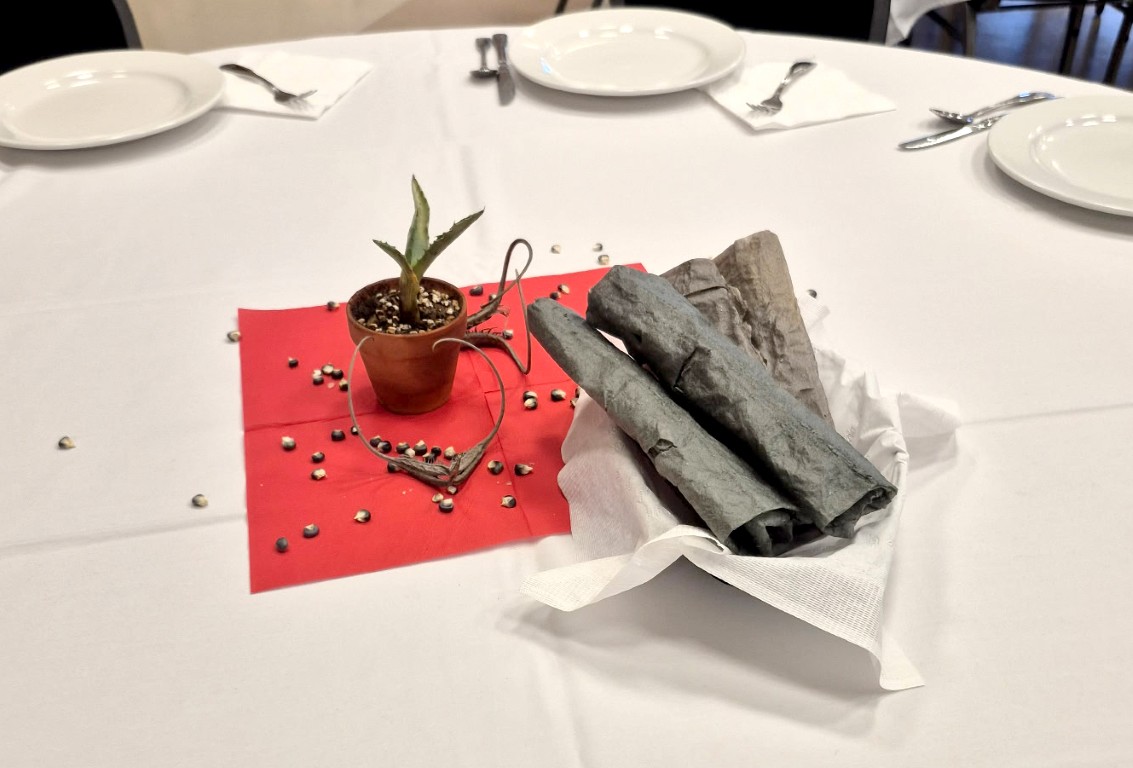
Chef Molly Beverly and her crew completed the story with a Hopi-inspired meal, featuring beef from L-Bell Ranch, produce from Whipstone Farm and Delicious Earth Farm, and piki made by friends in Kykotsmovi. The evening now had aromas, textures and flavors that inspired conversations and sharing of stories.
The gathering offered no universal recipe for farming in an arid land, but something better: learn the place, follow the water, protect community knowledge, grow what fits, and share what comes from the soil.
Chef Molly Beverly is Prescott's leading creative food activist and teacher. Photos by Gary Beverly.


