
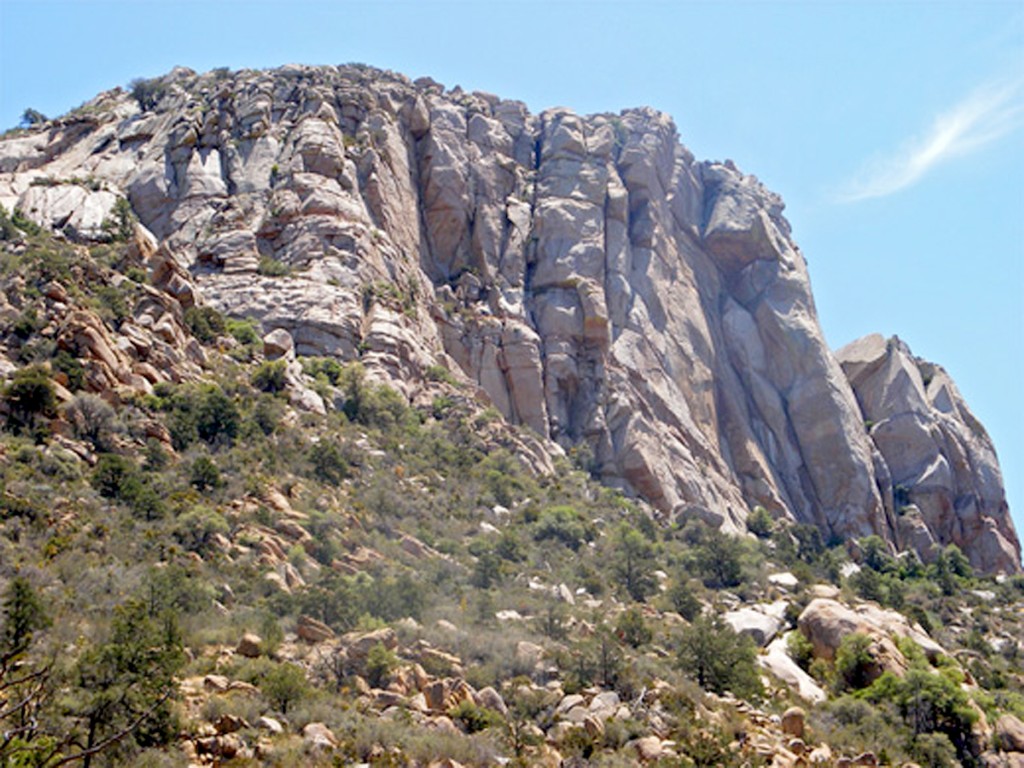
GRANITE MOUNTAIN is best known for its natural beauty, peregrine falcons and the famed Granite Mountain Hotshots.
My nonprofit, Preserving Arizona Wilderness, has just released its latest video, on Granite Mountain. The first part focuses on the mountain’s beauty and the falcons, and includes an interview with Prescott Master Naturalist Dick Yetman. The second part is about the Hotshots, featuring an interview with John Marsh, father of Eric Marsh, one of the 19 firefighters who died in the Yarnell Hill fire. Check out the videos here and here.
Much to see
Ragged boulders, some as big as a house, stack on top of each other to an elevation of 7,626 feet in Granite Mountain Wilderness. Some are hiking Granite Mountain for the first time, others have been hiking there for more than fifty years. The striking landscape, amazing rock formations and views are all great reasons for preserving the wilderness. Managed by the US Forest Service, it covers 9,970 acres and includes more than ten miles of trails.
Chaparral, a community of plants including shrub live oak, mountain mahogany, manzanita and lemonade berry bush, dominates the southern slopes, with scattered stands of piñon and juniper. On northern slopes you’ll also find piñon, juniper and some pine and oak higher up.
Mule deer and javelina inhabit the area, along with a mountain lions, bobcats, badgers, foxes, skunks, coyotes, rabbits and smaller rodents.
Hikers, horseback riders and hunters may be found here in abundance, on three trails totaling twelve miles.
Granite Mountain is popular among rock climbers for its sheer cliffs. Hikers walking along the south face get an impressive view of the cliffs soaring above them.
Falcon refuge
People debate whether the peregrine falcon is among the most beautiful birds, but what you can’t argue with is its speed. This bird of prey has a blue-green back, white underparts and a black head. Audubon calls the peregrine one of the fastest birds in the world, and National Geographic TV has clocked one at 242 miles per hour. It averages a twenty-year lifespan, is 13-23 inches long and has a wingspan of 29-47 inches. Because of the nesting sites the Forest Service closes off the cliff areas of Granite Mountain from February to July.
Challenging summit
Going to the saddle is a great moderate hike, climbing about 1,600 feet, offering great views and covering 7.6 to 8.2 miles, depending on which parking lot you choose. The first 1.75 miles go through a forested area with oak and maple trees. The trail is known for verbena, penstemons and many other flowers. Red thistle on the mountain entices hummingbirds.
After the saddle, the trail intermittently disappears, meaning lots of climbing up boulders, including for route-finding, involved bushwhacking and rock-scrambling. Maneuvering up these rocks offers many chances for injury, so don’t do this alone. I was with twelve other members of the Prescott Hiking Club, and several of them helped me make it to the top some years ago.
Getting to the top, at 7,600 feet, is most rewarding, not only for accomplishing what most people on this trail don’t do, but it also offers a 360-degree panorama of the many surrounding mountains, including the San Francisco Peaks, Kendrick Mountain, Bill Williams Mountain, the Bradshaw Mountains and Sycamore Canyon.
A fun side trip is to the famed alligator juniper that the Granite Mountain Hotshots rescued from the Doce Fire in 2013. This tree is believed to be the largest and oldest of its kind, over 2,000 years old. Today people honor the Hot Shots with memorials left at the tree.
Stan Bindell is always looking for a good hike. If you have one, contact him at thebluesmagician@gmail. com


