
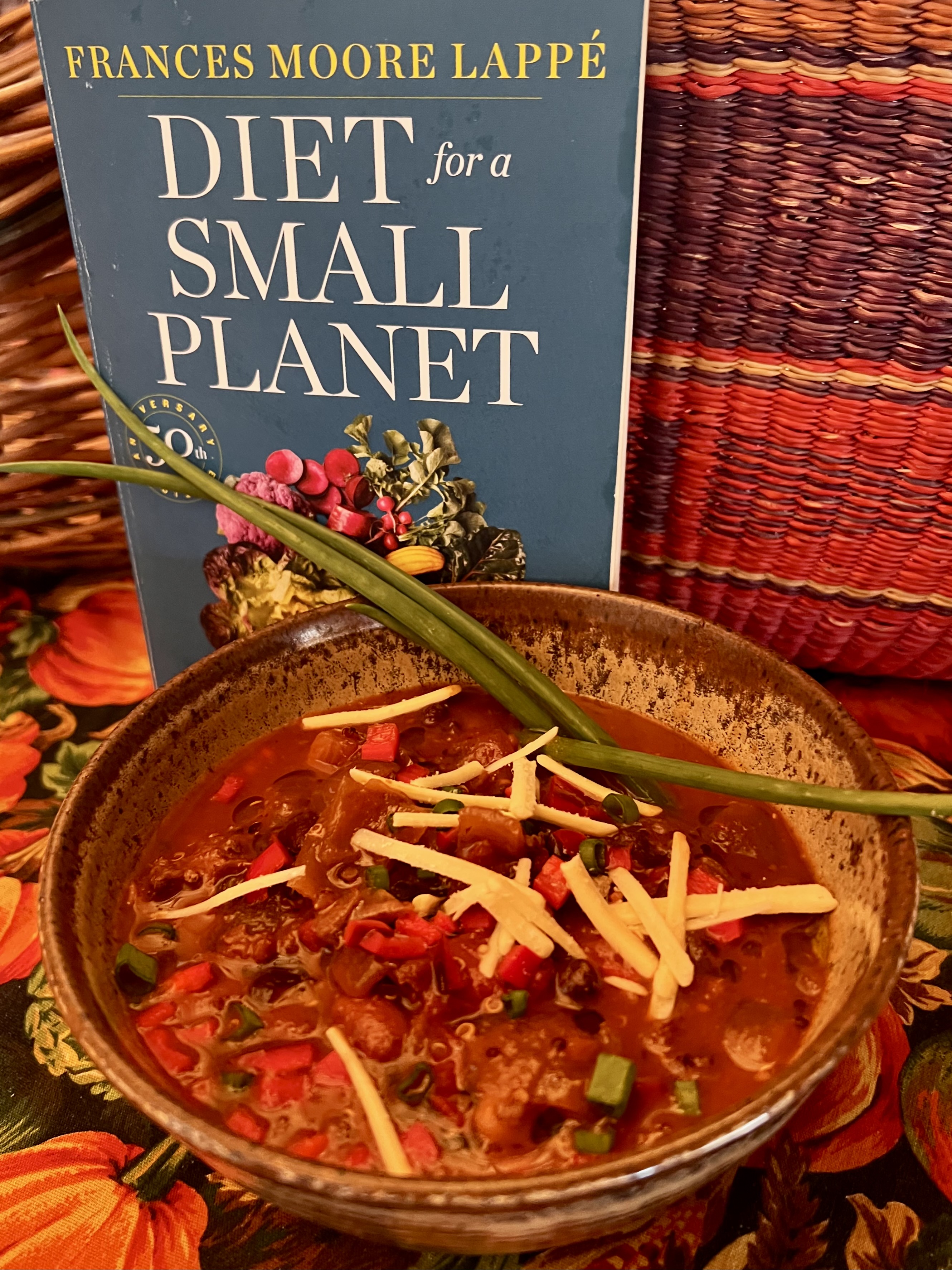
Chili (aka chili con carne) is a traditional Tex-Mex cowboy dish based on the ingredients they could carry — dried beef, dried beans and dried chilies. Annie Ryder and I reinvented it as a vegan/vegetarian dish when we taught Cooking with Natural Foods at Yavapai College in the late ‘70s.
We were inspired by Frances Moore Lappe’s book Diet for a Small Planet, an exceptional study that explains how a vegetable-centered diet could be protein-rich and address human-health, environmental and world-hunger problems. Diet for a Small Planet sold 2.5 million copies. It changed the way America eats and is “one of the most influential political tracts of our times,” says the Smithsonian National Museum. It’s been revised and reprinted five times, most recently in 2021. This 50th-anniversary edition is more pertinent than ever and well worth revisiting, containing over eighty new and delicious plant-based recipes from food stars like Alice Watters, José Andres, Mark Bittman, Sean Sherman and Mollie Katzen.
This chili recipe has weathered the test of time. I’ve taught it, cooked it, catered it and served it for almost fifty years, including the nine-year stint at Prescott College while I was food-service director. I made up huge pots and served hundreds, probably thousands, of bowls. I named it Crossroads Chili for the Prescott College Crossroads Cafe. It continues to be a big people-pleaser. I think I’ll serve it at the next Empty Bowls event in September. Meanwhile, you can enjoy it yourself. Just follow these steps.
Crossroads Chili
Step one: Gather what you need. For six generous servings you’ll need 4 cups of cooked beans. For the vegan version soak ½ cup whole-grain bulgur wheat in 1½ cups of warm water and set it aside. Bulgur takes on a meaty look and feel in this dish. (For the omnivore version you’ll need ½ pound of local or organic ground beef.) For both versions chop 2 large onions and mince 5 large cloves of garlic. Measure out ¼ cup olive oil and set aside. Measure and mix these spices: 1 teaspoon each of ground cumin and leaf oregano, 4 tablespoons of chili powder and/or sweet paprika (to taste). For the liquid component mix together 1 cup of tomato sauce, 1 cup of chopped fresh tomatoes and ¼ cup of good soy sauce (I prefer organic San-J brand). Set out salt, which you might want to add after tasting at the end. When you’re ready to serve you’ll need some crunchy fresh garnishes like chopped cilantro, green or red onions, radishes, bell peppers and maybe a grating of jack or cheddar cheese.
Step two: Build the foundation with caramelization and the Maillard reaction. Start with a thick and wide bottom pan that will hold 1 gallon. Heat at medium and add the oil, followed by the onions, garlic, spices and optional meat. Turn the heat to high and stir constantly. With the heat and oil the onions and garlic undergo a chemical transformation called caramelization that produces sweet, nutty flavors. When you brown the meat the amino acids (proteins) and fats are transformed by the Maillard reaction, producing deep, rich and complex flavors. Fat-soluble oils from the herbs and spices, including the chili powder, spill into the mixture. When everything is golden brown, move on to the next step. Don’t worry if some of the sugars stick to the bottom of the pan. This is the base foundation for full flavor.
Step three: Deglaze. Now reduce the heat and add the tomato and soy-sauce mixture. The foundation will bubble-spatter off the pan bottom and dissolve into the stock. Soy sauce plays an essential part in flavor, bringing rich umami depth to the mix.
Step four: Add substance, time and balance. Now add the beans and soaked bulgur (for the vegan version) and enough of their liquids to create a soupy consistency. Simmer over low heat for thirty minutes, stirring occasionally. Add more water if necessary. (Water evaporates faster at higher altitudes, like here, so keep an eye on it.) Taste and adjust for balance. Carefully add salt, chili or more of the other spice ingredients if needed. Taste and taste again. Get it perfect.
Step five: Finish fresh. Just before serving, garnish each bowl with a fresh, crisp garnish of chopped radishes, bell pepper, cilantro, red or green onions and/or grated jack or cheddar cheese. Your choice.
I hope you make more than you can eat in one meal, because Crossroads Chili gets better with age and will keep you warm and happy during the coming cold season.
Refrigerate for five days or freeze for months, and enjoy!
Chef Molly Beverly is Prescott's leading creative food activist and teacher. Photos by Gary Beverly.


