
Every so often you have a morning that unfolds exactly the way you hoped, where the birds you're looking for are present, cooperative, and behaving exactly as the field guides say they should.
I had one of those mornings recently while walking a trail around Willow Lake. Reports had come in about a rough-legged hawk, a species I rarely see, frequenting an area to the northwest of the lake. While we get occasional sightings of them in Central Arizona, they remain difficult to find and typically appear only during the cooler winter months. Historically, most local reports place them in remote grassland habitats. Grassland birding is one of my favorites, but carving out time to wander hundreds of acres in search of a single bird can be challenging these days.
This particular hawk, however, had been reported consistently in the same small area for several days. Better, a friend of mine, new to birding and especially fond of raptors, was free that morning. With that in mind I texted him asking if he wanted to try for the hawk.
We met mid-morning near the dog park and took the trail north from there. The weather was perfect: a crisp, classic autumn day in Prescott. As we walked we spotted some smaller passerine species such as American robins and Say’s phoebes, though overall the habitat along that stretch felt somewhat quiet. I quietly worried that we might strike out, but we kept moving. Soon enough, an American kestrel appeared, the first raptor of the day and a welcome confidence boost.
Not long after we entered a small pocket of bird activity. In quick succession we observed a ladder-backed woodpecker, a red-naped sapsucker, several scrub-jays, a flicker, a group of bushtits, a few yellow-rumped warblers, and a couple of bridled titmice. Three woodpecker species in five minutes — now the morning was starting to feel promising.
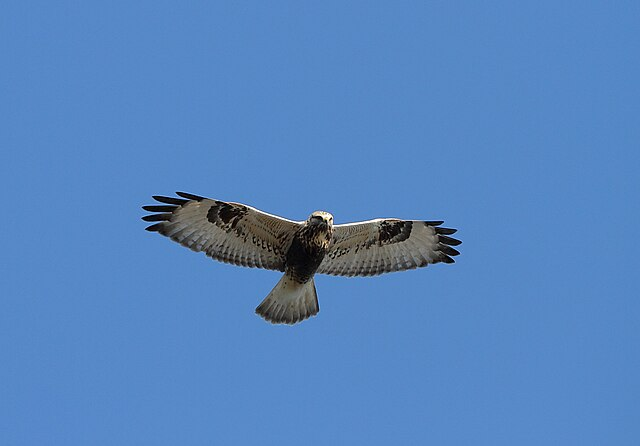
When we reached the general area where the rough-legged hawk had been reported, I paused to scan the skyline. There it was, unmistakable and perfectly positioned. In classic rough-legged fashion, it was kiting over a dry part of the lake, searching for its next meal.
Kiting is a behavior I’ve mentioned before, but to summarize, it’s a flight technique in which the bird uses an air current to remain suspended almost motionless in the air. Because rough-legged hawks are primarily grassland raptors, natural elevated perches are scarce for them, so this technique becomes their self-made ‘perch.’ While other raptors, red-tails included, can do this, rough-legged hawks are particularly adept.
We enjoyed great distant views before slowly approaching, till the bird was essentially right above us. We watched it kite, hover, drop to the ground and attempt to catch unsuspecting prey. It also displayed all the telltale field markings of a light-morph adult rough-legged. Most notable are large dark patches at the wrist of the wing and a dark, dense belly band. As we watched, two northern harriers drifted into the area, performing their signature low, slow, ground-hugging hunt with heads angled downward, listening for the faintest rustle in the grass. This behavior is so distinctive that even a quick glance can reveal their identity.
A few minutes later a small, fast raptor zipped into view over our right shoulders. Its size and speed initially led me to call out “merlin,” but a better look through my binoculars prompted a correction to Cooper’s hawk, followed quickly by a second correction: sharp-shinned hawk. Even experienced birders benefit from studying a bird as long and carefully as possible. My first instinct recognized the falcon-like speed, but the shape quickly revealed an accipiter, and its small size and flight style solidified the ID as a ‘sharpy’ rather than a Cooper’s. While those two species can look remarkably similar, years of watching them helps you notice subtle but reliable differences, and all signs that morning pointed toward the rarer sharp-shinned hawk.
For several minutes we watched the three raptor species share the area, hunting in close proximity to one another. Observing their unique behaviors side-by-side was a rare treat, especially for my friend, who was able to see textbook behavior happening in real time.
I love mornings like this, when the birds behave exactly the way the books say they will. It doesn’t always happen, but when it does, it’s invaluable for new birders and equally rewarding for seasoned ones. Building a mental library of not just appearance but behavior is what makes someone an effective birder. It takes time and deliberate attention, but the effort pays off immensely.
As the season continues to shift, get outside and see what species are showing up. The cool months in central AZ offer some of the best birding of the year. Enjoy it!
The Prescott Audubon Society is an official chapter of the National Audubon Society. Check it out online at PrescottAudubon.org.


