
A long long time ago, over 35 years, in fact, I migrated here to the Arizona high country from California. I came here to take a position as minister of a little church in Dewey.
California’s pollution and overpopulation were enough to drive me here to Arizona, where I breathe clean air and enjoy landscapes that resonate with Western history. I’d been called to the right church, an Arizona congregation that was open-minded. They accepted a woman minister; they enjoyed my love of stories, and they had no problem with progressive ideas.
Today, however, I’m musing about what I left behind in California, a monolithic state that lives in my memories and seems to be part of my soul. Scenes appear like photos in my mind, and I find myself remembering them as if they were vivid paintings. Looking back seems to enrich today’s monsoon morning as I recall my life in California.
Berkeley, where I studied religion, is a wonderful city, humming with conversation and stirring with unusual people. It has a tiny theatre, lots of bookstores, coffeehouses, hills of lovely homes and an unparalleled university. I loved living there in student housing while I attended seminaries led by different theologians. Classes were taught by Jesuits, Episcopal priests, a Baptist minister and a Lutheran professor. Locals called the seminaries ‘Holy Hill.’
Another cherished memory is of Catalina Island, a California gem. I worked there during summers in the town of Avalon. I cashiered at a little drug store, and I served as librarian in the tiny library. The island seemed always sunny and beautiful, with its charming bay of rocking boats far from the mainland. In memory I still enjoy cool seaside walks and vestiges of old Hollywood, left behind when movies were filmed there.
I spent some California summers in Three Rivers, a small community in an imposing redwood forest. My parents had settled there in retirement, far from the bustle of southern California. Three Rivers is a quiet place on Lake Kaweah. The tiny town, like Avalon, has a general store and a Protestant church that serves as a center for social life. Hidden somewhere among the trees is an enclave of artists. I’d visit Three Rivers after a hectic school term, and the place soothed my spirit — a river, a lake, tall trees, few people. I lolled in the river, enjoyed my father’s cocktails, and mostly slept. The redwood trees stood watch over everything.
The Pacific Coast is part of California too. Its stunning cliffs hover over wild rolling waves below. Tourists and sunbathers are not welcome in that uncivilized, dangerous coast. Though the beaches of the south attract thousands, these northern places are untamed. Only the hidden homes in the hillsides reveal signs of human life.
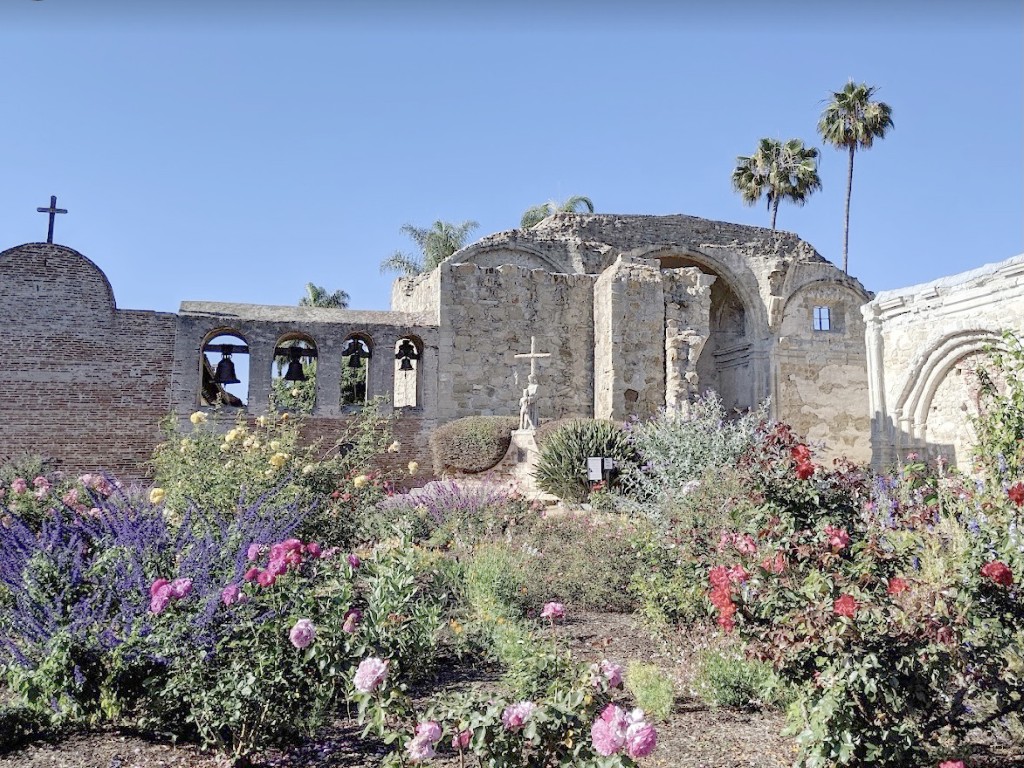
Even though my memories are pleasant, California history is not benign. Its lands were stolen from Mexico, and its vast thriving ranches were taken by invading hordes of pioneers and armies. Before that, the state was invaded by the Spanish Church. Their missionaries established centers throughout the state where they dominated the natives. Those mission churches still stand, and a Spanish atmosphere influences California architecture and place-names, including the mission town of San Gabriel, where I grew up.
The Mexican descendants of those whose lives were invaded still live and work in California, and they’ve not taken their wealth back. Instead, they live in modest enclaves where they can speak their language among people from their culture. Many work the vast fields of vegetables in the central valley. These descendants are a mixture of European and Indigenous Americans, the conquerors and the conquered. They are mestizos (‘mixed’) who’ve been exploited by our dominant white culture and are now terrorized by white supremacists. As I see it, they are treated as if they were the invaders and not the original Californians.
Early invasions continued with the California Gold Rush, lending a sense of ungoverned freedom to California life because the gold-mining areas were remote and unruly. Soon, after eliminating the buffalo and natives from California’s lands, adventurous folk came in wagons and stagecoaches to find fortunes and a new world where they could homestead. To my mind California still seems to be a place of wildcat opportunity, where movies are made and Disneyland flourishes.
When the railroads extended to California, it was invaded again, by folks enchanted by the weather, the freedom and stories of golden wealth. The two cities of Los Angeles and San Francisco expanded in another rush, with distinctive signature cultures. The one is boisterous and undressed; the other formal and operatic. I grew up in the shadow of Los Angeles, but I love San Francisco’s sophistication.
Memories of California are gifts of my old age, and I’m glad so much is still with me. Certain scenes provide delicious moments that remind me of a world I’ve left behind.
Elaine Jordan, author of Mrs. Ogg Played the Harp, is a local editor who’s lived in Prescott for thirty years.


