
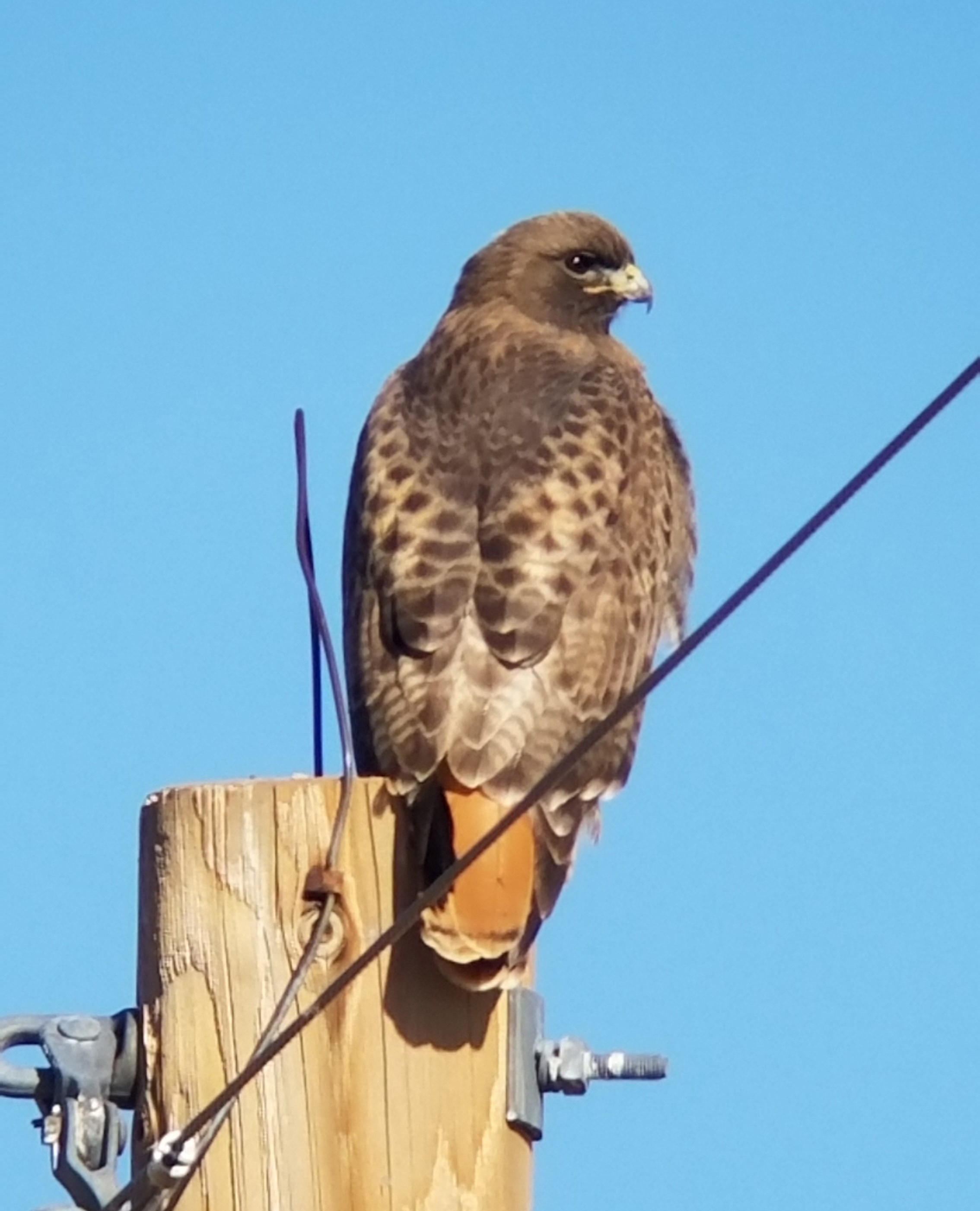
Sometimes when I sit down to write I know exactly what I want to say, as I’ve spent a couple of days developing the narrative in my head. Other times I cannot for the life of me come up with an idea. This was one of those times. When I find myself in that predicament, often I’ll scroll through the bird photos I’ve taken, hoping for inspiration. As I went through my images I came across a nice shot of a red-tailed hawk, and it struck me that I hadn’t yet written about this ubiquitous bird of North America. I had to go back and check to be sure, because I couldn’t believe I had overlooked this species.
Fortunately, any day of the year is a fine day to write about “red-tails,” especially in Prescott. In Arizona you’d be hard-pressed to go birding on any day in any part of the state without eventually spotting one. Their range covers most of North America and, while their numbers shift seasonally, Arizona sits comfortably in their year-round range.
While Prescott birders are fortunate to enjoy a diverse set of raptors year-round, the odds are strong that when you notice a large bird of prey atop a telephone pole, it’s a red-tail. They are among the largest raptors in North America, only the two eagles and the ferruginous hawk are larger. Their broad shoulders and chest give them a stocky posture, often with a slightly slouched appearance. While falcons and other species sit more upright, red-tails seem to get comfortable on their perches, sometimes appearing as if they are an extension of the pole beneath them.
Sitting on an elevated perch is often the best way to observe this keystone species. From these lookout posts, they scan their surroundings before gliding down to snare unsuspecting prey. Their diet consists almost exclusively of small and medium-sized mammals, but they are opportunistic. I once witnessed one snatch an American coot off Willow Lake — a reminder that while the books may outline their typical diet, hungry animals sometimes improvise.
Red-tails also hunt from the air and can often be seen soaring in wide, interlocking circles. One of their more innovative techniques can be studied on many Prescott mornings. In areas without suitable poles or snags, check out the air space above south-facing slopes or rocky outcrops. As the sun heats the ground, these slopes channel rising warm air into the atmosphere. Red-tails frequently ride these thermal columns, gliding methodically along the slope. If wind and thermal conditions align, you might also see them “kiting” — holding themselves nearly stationary in midair, much like a tethered kite. While this behavior is more common in smaller raptors like American kestrels, red-tails have mastered it as well, using the vantage to scan for movement below.
Large raptors can be challenging to identify, but like any bird family, learning the common species provides a foundation. For me, mastering the red-tailed hawk was key in my early birding years. Once you can confidently identify them, the rest of the raptor group becomes more manageable. A word of warning, though: don’t be overwhelmed by the dizzying array of field-guide plates depicting their many variations. While there are several subspecies and morphs, nearly 95% of the birds you’ll encounter here will be the typical “western” variety.
Their namesake red tail is a helpful clue, but it’s often hidden when perched due to their posture, and even in flight it can be hard to spot from below. Young birds and rare morphs may also lack the signature cinnamon color, so its absence doesn’t rule them out. Instead, here’s your homework: study five key features. Look up the “scapular V,” the “belly band” and the diagnostic “patagial patches.” Learn their overall shape both in flight and at rest. If you commit these five traits to memory, you’ll be able to identify 99.9% of red-tails you encounter, regardless of variation.
The best part? This is a bird you’ll have endless opportunities to practice with. Next time you drive to Chino Valley, challenge yourself to spot one. If you make the trip from Antelope Hills to Road 1 South and don’t see at least a single red-tailed hawk, I’ll personally take you to find one!
The Prescott Audubon Society is an official chapter of the National Audubon Society. Check it out online at PrescottAudubon.org.


