
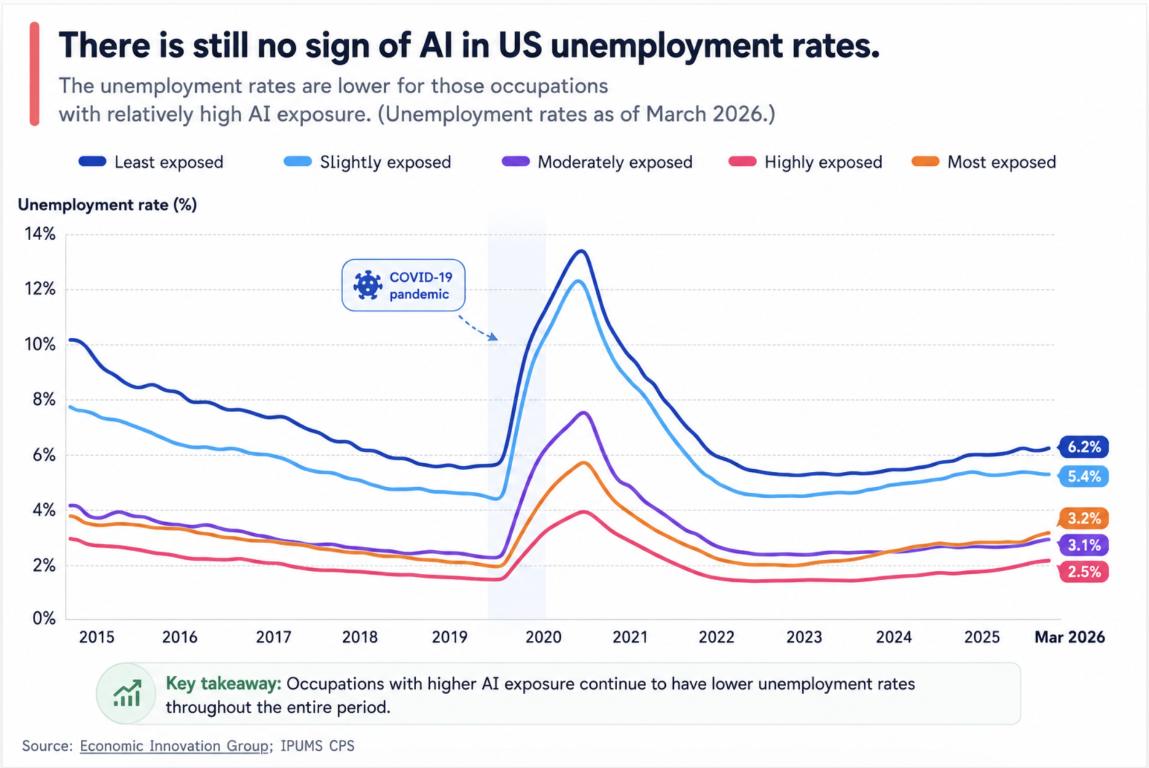
AMONG THE DEBATES raging in the AI sphere is whether it will replace workers en masse or mostly just support workers, as computers do, to speed up work and reduce labor-intensive tasks.
I think we’ll see a blend of both aspects, eliminating some jobs, speeding up others, and creating new jobs to maximize efficiency.
Many AI CEOs like to believe that we will someday all live in a utopia in which we don’t have to work, and AI will generate so much value that everyone will be guaranteed an easy life. I think that’s totally unrealistic, too.
People never stop striving to do and be better, and AI will definitely make complicated paperwork easier, but people want to deal with other people, not just machines. Customer service is one area that should always require people, though AI is taking some of those call-center jobs.
The MIT Technology Review in May 2026 reported that the effects of AI on the wider job market have been negligible so far. Erika McEnterfer, an economist for the Stanford Institute for Economic Policy Research, wrote, “we know from history . . . that it takes time for innovations to work their way through changes in industries and changes in occupations,” and that businesses will have to make the transition before labor markets are affected. US census data show that only one in five companies is using AI, and research from the Economic Innovation Group found that only 2-5% of jobs are “highly exposed” to AI replacement.
Current job losses are mainly in banking, computer programming and internet-based companies, where most services are already provided online. Most jobs eliminated have affected entry-level employees, which poses its own challenges for young people, but not the working public at large.
A recent story in The New York Times describes how one company created 13 new types of jobs by implementing AI. The company, Box, a Silicon Valley maker of software for storing and managing data, discovered it needed new employees to design and manage new AI systems. It expects to add at least 100 more people by next year. In addition, because the company’s AI systems are in demand, it needs more salespeople and managers to implement and train people on the systems.
Box was an early adopter of AI via ChatGPT, and it has seen an 11% increase in income just in the first quarter of this year, with more revenue to come as it expands. Its new AI job titles include ‘AI business-automation engineers,’ ‘forward-deployed engineers’ for clients who want to integrate AI products, and ‘AI-platform leader’ to oversee platform development. It has hired people who evaluate models and test them, as well as additional marketing professionals to specialize in new markets. Like all companies that use AI products, Box also needs more cybersecurity professionals.
While AI is generating new code, companies still need humans in the loop to check and test the code and tweak it when it doesn’t work properly. AI is not perfect by any means, but its potential for time- and cost-savings is tremendous.
A French company, Schneider Electric, integrated AI in its factories and has found that it’s making workers more productive in repetitive drudge work. It’s also helping call-center workers get faster and better answers for customers. A study on productivity found that AI assistance helped workers, on average, to resolve 15% more problems. One task alone, producing electrical contactor tips, is now being done with less water and electricity, with no further need for lab-testing and 22% less consumption of vehicle fuels, because its trucks are no longer driving to the testing lab.
Farming and manufacturing are among the areas recording great gains from AI technology, but since both are already highly automated, it doesn’t appear to be negatively affecting jobs.
China, surprisingly, has taken the lead in protecting workers from AI replacement via its courts, which are advocating for workers’ rights in lawsuit rulings. Labor law in China protects workers from being laid off.
A US superPAC called The Guardrails Alliance has raised $5 million (with a goal of $15 million) to influence Democratic races, favoring candidates who support regulating AI, including those who want to impose safety measures. Another superPAC, Leading the Future, wants to pass a national regulatory framework for AI that creates jobs for workers. It remains to be seen whether they’ll have any sway as AI companies buy favors in the administration and Congress.
Journalist Toni Denis is a partner in Seeflection Inc.


