
Baby-boomers have been around long enough to see the fruits of the personal-computer revolution that took about twenty years to fully deliver after overcoming software flaws and limitations.
Then we experienced the life-altering benefits of the internet, which gave us instant access to information, connection with other people and work simplification. As an early adopter I had a dual-floppy disc Kaypro and an AOL connection that allowed me to work remotely as a freelance journalist decades before it was commonplace. I ordered from Amazon when it was basically an online bookstore. Back then, my parents didn’t understand how their Christmas presents came from the internet.
Now we are in the AI era, and its promise is staggering. AI technology is already delivering returns far faster than any technology that has preceded it. By next year it will be apparent to everyone that it could impact every aspect of our lives, even more than the supercomputer they hold in their hands (any smartphone).
I can put this into perspective better than most people because I see firsthand how my husband’s AI company, ZON Energy, has had tremendous breakthroughs after years of effort. As the machines become smarter, their abilities become breathtaking and they deliver new, better results at a faster pace. The major AI companies are betting that 2026 will be the year superintelligence becomes undeniable, radically changing the way we solve problems.
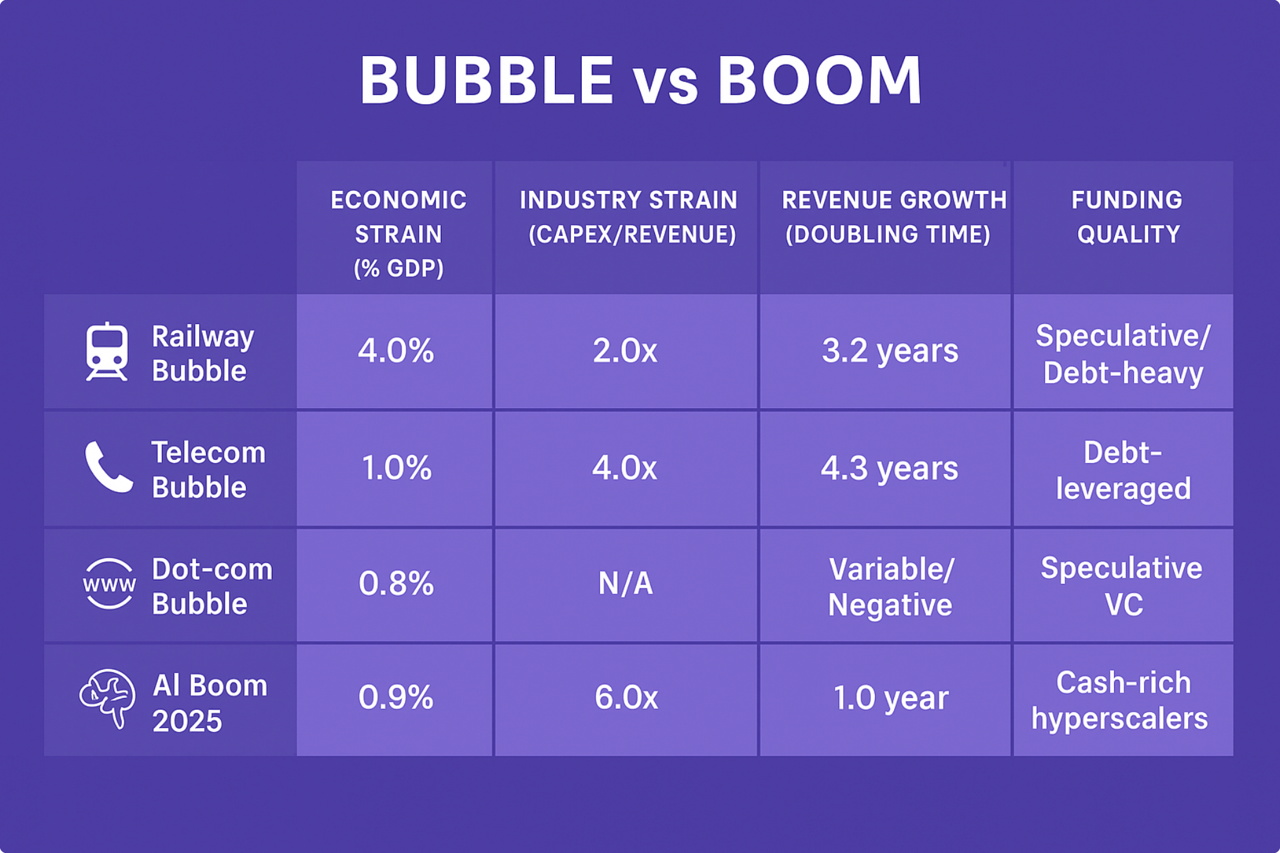
While people in the field understand the possibilities and real advances, outside observers continue to wring their hands and worry about a crash, like the bursting of the internet bubble in the late ’90s. Having been a co-founder of an internet company during that time, I can confidently say there’s no comparison.
In any new field, weaker players will fall to the wayside for a lack of uniqueness, inability to reach goals, or management that takes a wrong turn. But unlike the irrational exuberance that drove the internet bubble, returns on AI investments will pay out far sooner. While some large companies will take longer to make their returns on investment, their potential cannot be overstated. If anything, AI executives are underselling it.
How do I know this? Researchers have been crunching the numbers, and they’re showing that AI is achieving stacked exponential growth. That’s not hyperbole. The growth already exhibited is based on factors that make it difficult to compare with any other type of economic growth in history. For instance, AI is improving the performance of hardware at 3.4% per month. Algorithmic performance is doubling every six months. The quality and quantity of data is doubling every eight months. Useful applications and uses are doubling every twelve months.
These areas of growth will translate into real dollars.
On top of that, AI tools are accelerating AI research; AI systems are optimizing their own architectures and training; AI is creating training data for the next-generation models; and AI is optimizing chip architecture for AI workloads (these are research results from a ZON Energy white paper). That all means faster development and turnaround on products and projects.
At least one report concludes from analysis of those growth factors that AI’s growth is far from being a bubble, but rather an economic boom. See exponentialview.co/p/is-ai-a-bubble.
The good news
I love to learn about the good that AI is doing, especially when it comes to medical advances. One of the latest I discovered is a retina-implant chip that enables people who are vision-impaired to see close-up images. MIT’s Technology Review reported the development by Science Corporation in its recent newsletter. The “artificial-vision” chip allows users to text and do crossword puzzles, for instance.
The bad news
Both xAI and OpenAI are making pornography-related products using AI-generated “sexy” chatbots and graphics. While porn has traditionally driven much of technology development (the various types of video and streaming tech, for instance), it’s disappointing that these companies are pursuing the lowest common denominator. Already young people are using the xAI chatbots, and it’s not going well. I predict the companies will make a lot of money in custom porn, but considering the tech-bro history, I also predict that they’ll somehow cross lines and get in trouble.
Additional bad news is that Wikipedia’s traffic is sinking — down 8%, according to Pew Research — because users prefer to use Google’s AI summary over going to the website. Wikipedia is a curated website that does fact-checking on its postings. A chatbot or AI summary is rarely entirely reliable. Please support real websites over AI chatbots. They’re still the best sources of information, because humans are in the loop.
Journalist Toni Denis is a partner in Seeflection Inc.


