

ROGER TIPPING II is an entrepreneur, playwright, director, theatre producer, actor, composer, pianist, and jazz singer. This year he directed Murder on the Orient Express for 4th Wall Productions and two original plays, It’s a Wonderful Life? (Endeavor Theatre Co.) and So This Is Christmas. I spoke with Roger about his projects and process.
How did you get involved with theatre?
I actually hadn’t done any theatre since I was 16.
I had been attending shows at PCA, which was in danger of closing down, and some of us wanted to join the board and see if we could help turn things around. Jersey Boys needed to be very financially successful; it was one piece of the puzzle if we were going to survive through the end of the year. My thought was, ‘if I can help make this show better, and we can help make the show successful, then it will help the theatre survive.’ And then once I got into it, I realized, ‘Wow, I really love doing this.’
This year has been non-stop theatre, and that’s sort of what I’ll be doing for the next — until I get burned out, I suppose. Theatre’s probably the only thing I’ve ever done where I got that initial surge of joy from doing it, and then after doing it multiple times, I realize that I don’t think that will ever diminish, and I’ll always want to keep doing it. When you add the layer of community, which is another thing that’s really important to me, what else is there that is similar in very many ways at all to what community theatre is?
You progressed from acting in Jersey Boys to writing and directing fairly quickly.
It actually started with the cast of Jersey Boys. It was a really tight-knit group, and after the show we were wondering what we could do as a group for Christmas, so I recruited Layla Tenney’s help to write So This Is Christmas. We were casting and actually started rehearsing while we were writing it; by the time we finished writing, we were a week out from opening (the workshop production at Stage Too in 2024). The whole process was six weeks. I kind of wrote something, I kind of directed something; I can’t really remember because it’s all a blur.
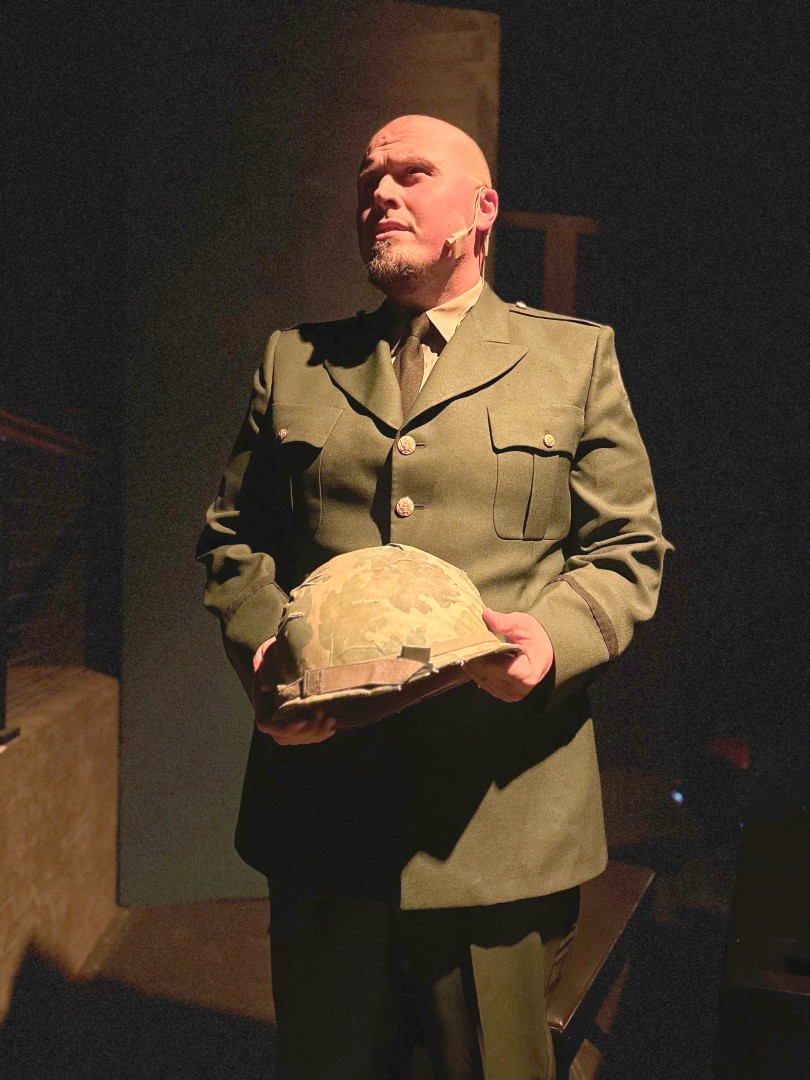
Between then and this year I read more about narrative storytelling, and I realized I wasn’t going to be able to get the rights to the music for the show, so I made the choice to write original music instead. That gave me more flexibility to go in and modify some parts of the script; I had written the narrative around the songs that were in it. Songs are so integral to storytelling in a musical — writing your own music, you can literally do whatever you want, so I was able to connect the dots on some little details in the narrative arcs for the characters. I got the rights to “I’ll be Home for Christmas” and I kept “O Holy Night.”
Believe it or not, “O Holy Night” always felt like it was going to be the riskiest piece in the show. The lyrics to that song are explicitly religious, but its use in the story is not religious at all. The character sings this song not because of the meaning that the lyrics carry, but because of the musical emotional arc that the song has. I still don’t know how much of the audience gets that, but I do know that it evokes the right reaction; it makes people feel the thing that I wanted them to feel.
In anything I write, that’s a big part of the goal: Can you take people on a journey that evokes a pattern of emotions that create a comprehensive experience? That’s why I like making art, and that’s why I like experiencing art. My own subjective definition of art is that the observer gives the artist implicit permission to emotionally manipulate them, so that they can experience something meaningful.
That’s an interesting transition point to It’s a Wonderful Life?. I’ve heard a lot about the emotional journey your actors went on in the show. What is “devised theatre”?

As a group of people, through various improvisational mechanisms, you come up with the setting, the story, the dialogue, the characters, everything comes from improvisation, and no one person is responsible for what you’ve created. This departed from that in the sense that I started from a rough sketch of the narrative, though some of the devising did impact the overall story.
I started with two overlapping narratives for the story, one being George Bailey, and the larger one being the ensemble of the show as the hero, but actually as a proxy for the audience and how they relate to George and the concept of social expectations, how some people place on others a burden of expectation that maybe is unfair. That was really the story that I wanted to tell, but the cast didn’t actually know that until the end. The narrative was revealed to the cast chronologically throughout three months of devising. My thinking was that if you want people to devise really effectively within their characters, then they shouldn’t know things their character doesn’t know. If the actor knows the character’s future, it will impact the choices they make when they’re devising.
How much latitude did the actors have about how their characters developed and how they moved forward through the space of the play?
A lot. You asked about the emotional impact for the actors, and I think a lot of the impact was how much latitude the actors had, not just to decide where their characters were going, but how much of themselves to bring into the character. There is automatically some opportunity for a therapeutic experience of bringing yourself into a character and then pushing that character somewhere you want them to go for personal reasons, and I think that was a big part of the story and each character’s narrative arc.
I heard the word “betrayal” from several of your actors. Do you want to speak to that?
(Laughing) I knew from the beginning that we were writing a tragedy, but they didn’t know that. So I think a lot of them were really hopeful that there was going to be an ending with a nice bow on it that made them feel really good about their characters, and the story, and themselves, and that was never the goal. I felt that the kind of story we’re telling, and especially the social dynamic that I wanted to point a finger at, is tragic, and also the show deals with the inherently tragic subject of suicide.
Along the way, each character devised a scene with George on the bridge, and many of those scenes weren’t in the final show, but it was a prompt for me that a lot of the story sort of derived from: what happens when a person who, in a very complicated way, thinks that they’re solving problems for the people around them by removing themselves from existence, and what happens years later, when they meet them for the first time again in Purgatory? What would that conversation look like?
There is one way I lied to the cast, and it was that I told them that George does not know that he’s dead. But in six weeks of devising, Jacob (d’Armand) never lied about it. The actors would say things to him like, ‘You’re dead, George. This is Purgatory,’ and though George secretly knew the truth, he would deflect rather than lying. That was a much stronger choice; I wish I had thought of that.
What’s next?
There’s a full slate of shows next year, so we’ll see. Next summer is The Last Five Years at the Cosmos; we’re self-producing the show, which was one of the first shows that was canceled by PCA when they started going bankrupt. We got everyone involved back together two years later to put it up on the same stage.
Whatever I write next will be heavily shaped by whomever is involved. To me, the idea of involving other people so I can do the thing I want to do is way less meaningful than finding a group of people who are interested in building something together and allowing everyone to put their own stamp on it.
Doing this work is a huge honor for me. I’m learning on the job in a very real way, so I bring a lot of humility into the process. I barely know anything. But being able to do that and, even with the lack of experience, being able to put things in front of people that really impact them is incredibly rewarding. The amount of gratitude I have for this community in general — I don’t know that there’s that many places where you could sort of walk in and show an interest in something and be given opportunities to do things that you really haven’t earned, other than just being willing to show up and do it. But that’s the only way you get good at it, and someday I will be good at it.


