
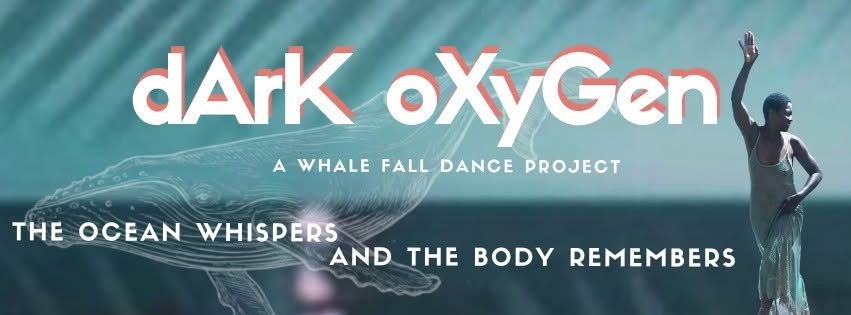
GENERATIONS of scientists believed that oxygen could only be produced in sunlight through photosynthesis. Then came the discovery of ‘dark oxygen,’ oxygen being produced in the deep ocean without light. For artists Mayfield Brooks and Camilo Camar that discovery became more than a scientific headline. It became a question of breath, survival, spirit, ecology and community.
The Carpetbag Brigade Curates brings The Whale Fall • Dark Oxygen Dance Project to Yavapai County, with all Prescott events taking place at the Hazeltine Theatre. The project includes a dance liberation workshop, a screening of Brooks’ experimental dance film Whale Fall, and two performances of dArK oXyGen June 19–20.
The work offers something that is both deeply contemporary and ancient in feeling: part performance, part soundscape, part ritual, and part environmental meditation.
Brooks, a New York City-based choreographer, movement artist, vocalist, filmmaker and 2021 Bessie Award nominee, describes the performance as “a sonic dance installation.” It is not a traditional scripted dance performance, though it does have structure. Instead, it unfolds through improvisation, voice, movement, live sound and shared breath.
“We always improvise within the structure that we create,” Brooks said. “I like to call it a ‘sonic dance’ installation.”
That distinction matters: dArK oXyGen is not just something to watch, it’s something to enter. As the audience enters, the room is already alive with sound. From there Brooks and Camar guide the space deeper and deeper, like a descent into the ocean itself.
The sound world is created through ocean drums, hydrophones, water, voice, synth, percussion and electronic effects. Brooks sings into water. Camar helps shape the environment through sound and movement. The result is not simply music accompanying dance, but an immersive experience where sound, body, breath and atmosphere become inseparable.
For Brooks the discovery of dark oxygen opened a way to think about hope emerging from darkness. “This whole phenomenon has inspired this work, and we’re thinking about it in terms of hope coming from places of dark, and how to breathe in times of darkness. How do we catch our breath, find our breath, move with breath?”
That question of breath carries many meanings. It reaches into the body, into grief, into the Black Lives Matter movement, into gospel music, into the ocean, and into the collective exhaustion of the moment. Brooks connects the work to the phrase “I can’t breathe,” but also to the possibility of finding breath together.
“There’s also me tapping into my background as a child gospel singer,” Brooks said. “There are elements of gospel music in it, and for me that’s another form of music that has come out of struggle, has come out of darkness, but it produces light in people’s lives.”
That sense of struggle becoming song is one of the spiritual undercurrents of dArK oXyGen. The piece asks what it means to breathe when systems, histories, technologies and environmental destruction make breath difficult. It also asks what kind of freedom becomes possible when people breathe together.
The June 19 performance, falling on Juneteenth, brings another layer to the work. Brooks sees a natural connection between the holiday and the performance.
“Juneteenth is about freedom,” Brooks said. “This piece is so much about freedom of expression and finding the breath. When we can all breathe together, there’s a freedom in that, there’s a joy in that, there’s a release, and that’s how we’re able to make our voices heard.”
For Camar, who was born in Colombia and is an artist, spiritual and environmental activist, designer and movement-based performer, the work is rooted in water and community. He describes the performance as a shared ritual, a space where people can gather with intention and reconnect with the waters around them and within them.
“The most important thing for me is a space for sharing community,” Camar said, “how we care for these waters, and the waters are an element that we associate with emotions. For me, it’s creating a kind of ritual process where we all can come together.”
That idea may feel especially resonant in Arizona, where the ocean is far away but water remains central to survival, identity and imagination. In a desert landscape, dArK oXyGen brings the ocean into the room not as scenery, but as a living presence.
The performance also carries an environmental message. The dark-oxygen discovery is tied to deeper questions about deep-sea mining and resource-extraction from ocean ecosystems. Brooks and Camar draw a parallel between the machines that mine the sea and the systems that mine human attention, fear and disconnection.
“The mining that is happening in the ocean is also happening in our minds,” Camar said, connecting to the ways social media, news and technology can pull people away from one another.
For Brooks, the ocean is not separate from human life. Its health is directly connected to our own. “Through our work we want to always bring awareness to the health and life of the oceans and preserving ocean life, .... That also preserves human life and life on earth.”
Before the performances, Prescott audiences will have a chance to participate more directly in the artists’ process through the dance liberation workshop "Subtle Pleasure, Open Heart," held June 16 4–6pm in the Hazeltine. The workshop will explore somatic techniques, improvised dance scores, imagination, vocal work, symbolic action, and heart-opening practices rooted in joy and pleasure.
Brooks is clear that participants do not have to be trained dancers. “You don’t have to be a dancer to come to the workshop,” Brooks said. “It’s all about liberating the body and the voice within these sonic and embodied explorations.”
The workshop invites people to arrive as they are, bringing their own stories and life experiences into the room. Through movement, sound, play, breath and community, participants will explore what it means to release tension, embrace wildness and open the heart.
That evening at 7pm the Hazeltine will host a screening of Whale Fall, Brooks’ 2021 experimental dance film. The film takes its title from the process that occurs when a whale dies and falls to the ocean floor, where its body becomes nourishment for deep-sea life. In Brooks’ hands, that image becomes a meditation on grief, Black life, ecology, darkness, decomposition and transformation.
Together, Whale Fall, the workshop, and dArK oXyGen create a weeklong invitation into the depths. The project offers no easy answers. Instead it asks audiences to listen: to the ocean, to the body, to ancestral memory, to the breath, and to one another.
In Prescott, where community often forms through shared rooms, shared stories, and shared acts of imagination, dArK oXyGen arrives as both performance and offering. It is a prayer, a meditation, a sound bath, a dance, and a call to awareness.
As Brooks put it, the work asks how we remain committed to “taking care of the earth, taking care of the ocean, and taking care of each other.”
Or, as Camar added near the end of the conversation, breath itself may be where freedom begins.
“When we can breathe,” Camar said, “we can be more aware and have the freedom to respond instead of react.”
Events at the Hazeltine
June 16, 4–6pm
Subtle Pleasure, Open Heart Dance Liberation Workshop
June 16, 7pm
Whale Fall Film Screening
June 19–20
dArK oXyGen Performance


