
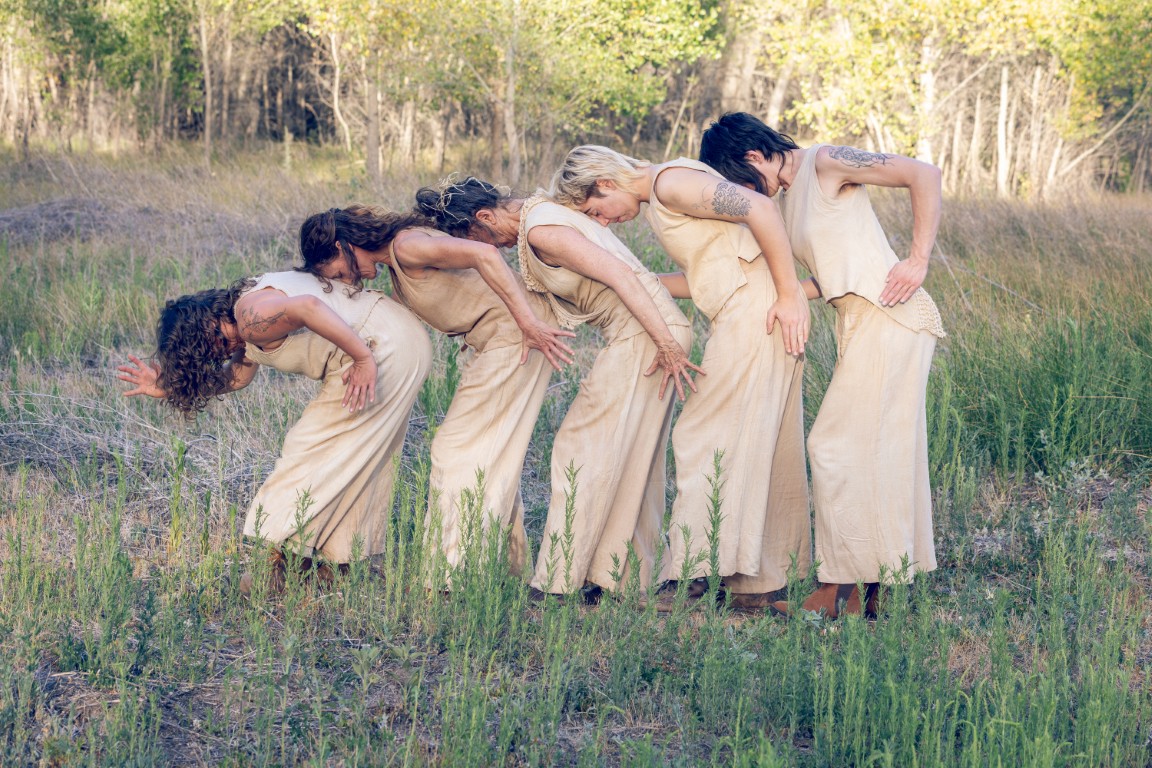
What exists beneath our feet is easy to overlook. Soil becomes something we walk across, dig into or brush from our clothes. Yet beneath the surface is a living world of microbes, roots, decay and renewal, an interconnected system continually transforming what’s broken down into new life.
That hidden world becomes visible in Inner Ground: A Mycelial Dream, an original multimedia dance performance premiering at the Cosmos Theatre. Directors by Delisa Myles and Ashley Fine combine movement, personal storytelling, soil science, projected imagery, sound and an elaborate set to explore what happens both beneath the earth and within ourselves.
The idea began more than two years ago during a shared hike. Fine had heard a radio story about scientists placing acoustic probes in the earth and recording the sounds of microbes in healthy soil. For two artists who are also gardeners and growers, the concept immediately inspired questions. What was happening beneath the surface? What could people discover if they listened without disturbing it?
Those questions developed into conversations about darkness, decomposition and the way broken material can become the foundation for new growth. Soil became both the subject of the performance and a metaphor for memory, grief, healing and renewal.
Myles, Fine, Aaron Wilson, Bonnie Miller and Jennie Wolfe perform the collaboratively written piece. Each performer contributed writing, movement and choreography, while Myles and Fine shaped the larger work as directors.
The creative process came to resemble the mycelial networks at the center of the production. The group gathered for intensive retreats, sometimes spending several days eating, sleeping, talking and creating together. Artists and community members were also invited to view works in progress and offer feedback, allowing the performance to continue changing through connection.
Myles describes the finished piece as a collage. It moves between deep grief and personal stories to moments of humor and strangeness. In one scene the performers imagine the world from a microorganism’s perspective through a “microbe line dance.” In others they uncover experiences that are often kept hidden because they are painful to revisit.
“There is so much healing available when something that has been underground or buried for a long time starts to move and grow and change into something else,” Myles said.
The earth itself becomes part of the performance. A wheelbarrow filled with finished compost will enter the space, giving the dancers soil with which to interact.
Above them will hang a branching fiber installation created by set and visual designer Diane Gilbert. Named Arnica, the web resembles an underground mycelial network. The performers can raise, lower and move through it, making the set another living presence in the production.
Gilbert also researched protozoa, microbes and invertebrates, transforming their forms into projected images that guide the audience through the work’s shifting emotional and ecological landscapes.
The performance will be staged in the round, with audience on all sides. This makes the choreography more complex, but it also supports the central theme: there is no single viewpoint in a root system, a community or a human story.
At one point, the performers conduct CPR on the earth, listening for signs of life and asking whether the ground is healthy. The moment connects the human body to the planet, suggesting that caring for the soil is inseparable from caring for ourselves.
Inner Ground: A Mycelial Dream will play in the Cosmos Theatre October 8–11.


