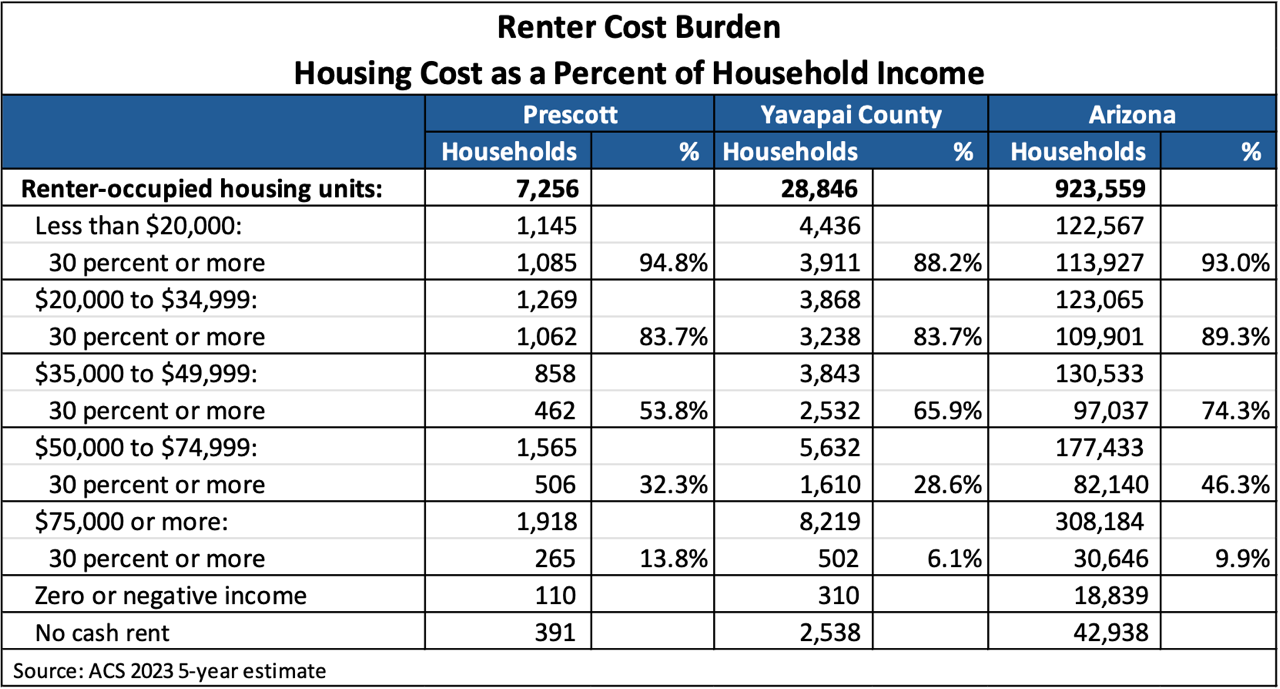
For at least the past ten years City officials in Prescott have been talking about workforce housing or, as a committee in Prescott Valley called it, “attainable housing.” The problem has been identified, discussed, promoted and in theory addressed by some builders. But it’s a long way from being solved.
The latest reports, funded by federal grants and executed by the same consulting firm in both cities, indicate that the problem has only grown in scope and severity since the pandemic. The Prescott report, released in May 2025, led to additional scrutiny of the problem, as did the one in Prescott Valley in October.
On November 4 the Prescott City Council approved a workforce-housing framework with guidelines for encouraging development of housing that is “no more than 30% of household gross income, including utilities.” Among its goals is to get developers to meet workforce-housing certification criteria by providing housing within the income range, setting aside a portion of total units for workforce housing, maintaining affordability for 30 years and other guidelines.
In return the City may pay a portion or all of development impact fees, defer impact fees for market-rate units in mixed developments, and potentially waive or reimburse other fees. These include fees for building permits, planning and zoning, site-plan review, subdivision, building-plan review and inspection, utilities-department action and others. In addition the projects will be given high priority with expedited review. Developers may also build at a higher density than in other projects. Projects will be considered on a case-by-case basis.
Prescott City Councilmember Patrick Grady, recently appointed to the Workforce Housing Committee as its Council representative, said the framework is a starting point for focusing on narrowing options from twenty to two or three that would have the “most financial impact.” He says the committee needs to do a more extensive analysis of the options. He hopes it will recommend specific financial incentives sometime in 2026.
“With respect to Yavapai County itself, we did approve to move forward with a program like its ‘A Home of Your Own’ program of several models of one-bedroom, two-bedroom and three-bedroom units that are already approved, so that if there's a developer who wants to build those models that already have approval, that would expedite the processing of their plans.”
Ten years of all talk, no plans
Looking back at the failure to execute a viable workforce-housing plan made it clear to current Councilmembers that developers need financial incentives to pursue workforce housing. Connie Cantelme, an outgoing Councilmember who didn’t run for reelection, said that removing obstacles for developers and enabling them to make a profit are key to making any plan work.
The grand expectation that 255 workforce-housing units approved near the airport, touted when that land was annexed into the City, evaporated when people who wanted to move to Prescott began bidding up the prices from an expected low to mid-$400,000 range to over $600,000. The builders had no restrictions or written requirements to keep prices in the “workforce” range, so they sold to the highest bidders. So much for official encouragement.
The construction of many new apartment buildings over the past five years has provided more housing, but most have rents that are barely within reach for many workers, including teachers, hospital employees and young people.
Now the problem is so bad that Prescott is losing police officers, firefighters and other government workers, who can command higher salaries and find lower-cost housing in the Phoenix suburbs.
In addition, seniors in two housing complexes built with federal low-income housing tax credits thirty years ago are now facing eviction with nowhere to go, because those complexes are no longer required to operate for senior citizens or those with low incomes, and are being sold.
Rent increases alone are threatening to drive many elderly women out of their apartments, say several interviewed by The Daily Courier last month. Many on fixed incomes are facing $100 monthly rent increases.
Chino Valley and Prescott school districts, desperate to bring in new teachers, have developed some manufactured housing on district-owned land to provide affordable living arrangements. Yavapai College has tiny-home developments on its campuses in Chino Valley and Clarkdale.
While other rapid-build alternative housing has yet to materialize, such as prefabricated housing units like Boxabl and 3D-printed homes, Prescott Valley helped speed approval of a small stick-built rental home development south of Highway 89A. The Pronghorn Group opened the first 45 single- and two-story units in October in the first phase, and they are completely full. The two-bedroom bungalows are 351 to 800 square feet in size and rent is $900 to over $1,000 monthly. Ultimately a total of 140 rentals will open on the six-acre site.
On November 14 the Yavapai County Contractors Association and Arizona Town Hall convened a roundtable at Espire Sports in the Pine Ridge Marketplace. Grady, who attended the event, said it drove home to him that workforce housing is a regional as well as state and national issue.
“I think what came out of that is that we need to look at this regionally,” Grady said. A former director of the Phoenix Community and Economic Development Deptartment, Grady says it’s a vital economic issue for the region.
“Workforce housing can impact economic development and employee recruitment and retention,” Grady said. “It could be really helpful for the City as an employer, and could attract employees, and be attractive to employers.”