
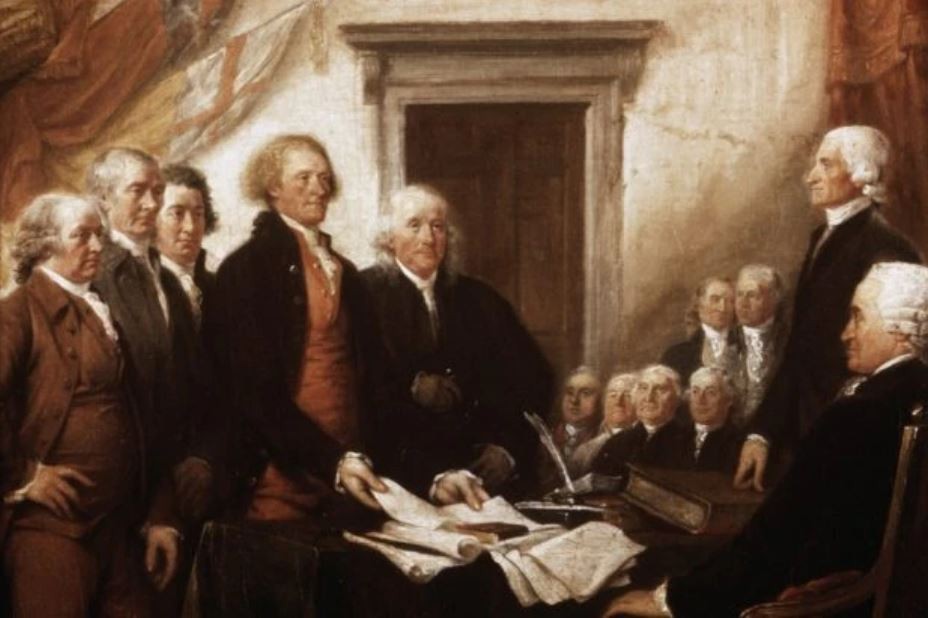
As (if?) we celebrate the 250th anniversary of the signing of the Declaration of Independence, it’s natural for those of us of a certain age to look back to the bicentennial celebration fifty years ago. I remember it vividly, but not for the fireworks.
I was two years out of high school, and my brief time at Michigan State had landed me my dream job as a prep-shop intern at the Grand Rapids Public Museum. Richard Nixon had finally resigned in disgrace. The ‘74 elections had brought fresh air and a spirit of reform to Washington. The war in Vietnam was over, and with tentative official steps to do better the war in the streets had abated. In ‘76 we elected the most morally astute and public-spirited president of my lifetime, and in many ways things were looking up.
But jobs were scarce, pay was low, and inflation was grinding away at the economy. By ‘77 I was out of a job, like so many others. For six months I beat the street looking for work, living on occasional music and theatre gigs, barely hanging on to my cold, shabby hundred-buck apartment. Never mind a car, rent and food had to come first.
For all that I still couldn’t have imagined that fifty years on we might descend into this parody of the Gilded Age, where a tiny number of unimaginably wealthy individuals have allied with an army of morally bankrupt con artists and racist foot soldiers to whip up fear in every direction and steal our democracy from us.
Things are not looking up. This anniversary comes to us in the middle of a fight over the very idea of America as a good place for good people.
I see this as an opportunity to rededicate ourselves to the values and resolve of the revolutionaries of ‘76, who decided that the highest value of government is to prevent the abuse of power by assigning supreme power to ourselves as a people.
The Declaration illustrates this perfectly through its extensive list of specific abuses by the British monarch, laying out the moral basis and necessity for not just throwing off an abusive government, but repudiating its legitimacy and form entirely, to embrace the radical idea of collective self-government.
In the entirely improvised process of designing, debating and instituting this new political idea, the founders clearly understood that the experiment, as we so often describe it, carries the inherent danger of mob rule and the elevation of a new despot. Preventing this was their primary concern in building a system of interlocking, interdependent power centers, diluting authority and making it universally accountable to the other branches and ultimately the will of the people. But they knew very well that the system’s core strength could become its core weakness if we were to fail in our commitment to shun the evil twins of despotism and corruption.
Americans have struggled with this problem ever since. Our history has been dogged with the shameful effects of corruption and its glaring and horrifying failures. The Gilded Age institutionalized corruption. The 20th century systematized it for the modern age: the ‘Great War.’ The Roaring Twenties. The Great Depression. World war again, worse. The Red Scare. World-killing weapons. Cold War. Vietnam. Nixon. The grubby Age of Greed and Terror. Our planetary climate in crisis. And now our would-be king, repeating verbatim the abuses of George III with vindictive glee while the systems we relied on to prevent it are being systematically dismantled, our courts undermined, Congress apparently impotent in the face of miscreants who simply disregard any authority but their own base urges.
With this record, why would any thinking person imagine that our form of government, its institutions and customs are worth preserving?
For me that’s the wrong question. The only right question is what we will do about it.
The founders left us self-governance and with it the ultimate responsibility to maintain it and use it. We are not bound by our government. We bind it, we control it, but only as long we’re not just willing but determined to do the work.
I’ve often said that any form of government can work positively if it’s administered by skilled people of good will, and any form of government will fail if controlled by incompetent or corrupt people. In other words it’s not the system, it’s the people.
Our problem is not just those of us who are acting badly, by any means. The essential challenge for democracy is maintaining our commitment to it and applying it prudently, wisely and broadly to the unending work of ensuring our shared prosperity and security. It’s a challenge of faith, not in the system but in ourselves. It’s a challenge of vision, to see a positive future and work to achieve it, as the founders did, and build it into our lives.
I still believe in the essential goodness of people, but experience has shown we must insist that our society reflect those values and our government serve our real needs. We can’t win this battle by sitting on our collective asses, hoping it will get better and trying not to think about it. We have to mobilize our values in active pursuit of the great promise of America, drive the bad actors back into their shadows, and insist on what we all know is right.


