
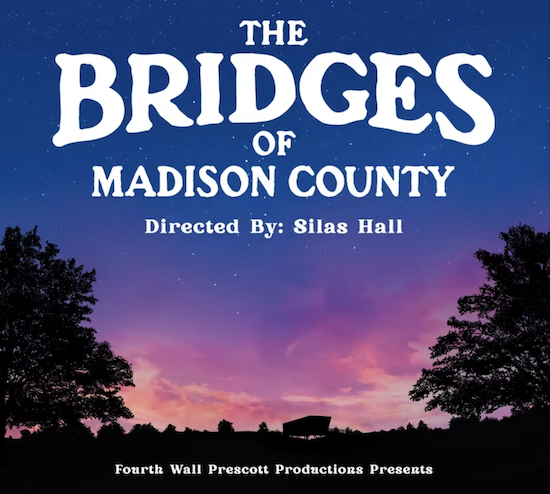
Some stories find their way into our lives through the pages of a book, others through the magic of cinema. But what happens when a beloved story takes the stage, where music, movement and human emotion bring new dimensions to characters we thought we already knew?
That is the challenge director Silas Hall has embraced with The Bridges of Madison County, presented by Fourth Wall Prescott at the Hazeltine Theatre. Based on Robert James Waller’s bestselling novel and the 1995 film, the musical features a Tony Award-winning score by Jason Robert Brown and book by Pulitzer Prize-winning playwright Marsha Norman. For Hall, bringing this romance to the stage is an opportunity to explore love, personal identity and the decisions that shape our lives.
More than a love story
Set in rural Iowa in 1965, the story follows Francesca Johnson, an Italian war bride who has built a quiet life with her husband and two children. When her family leaves for the state fair, a chance encounter with traveling National Geographic photographer Robert Kincaid disrupts her familiar routine. Over four unexpected days, Francesca must confront questions of love, loyalty and the life she might have chosen.
For Hall the story reaches beyond a conventional romance about an extramarital affair. “What this show is about is a woman deciding what she wants,” Hall explains. “If it’s anything less than that, then we’re missing the point.” He has worked closely with lead actress Taylor Cienica to ensure Francesca’s decisions reflect her own desires rather than simply reactions to the men around her.
That interpretation also requires a more nuanced portrayal of Francesca’s marriage. Hall has resisted making her husband Bud an unloving villain. During rehearsals he challenged the actor playing Bud to find affection in ordinary domestic interactions. Making Bud unsympathetic would make Francesca’s dilemma too easy. By presenting a marriage with genuine love and history, the production asks audiences to consider what happens when conflicting emotions exist simultaneously.
Between reality and fantasy
Translating Iowa’s landscapes and iconic covered bridges into the intimate Hazeltine Theatre presents creative challenges. Hall, who is designing the set and lighting, has developed a visual concept contrasting reality and fantasy. The scenery represents Francesca’s familiar world, gradually becoming less defined as the characters move into their dreams and desires. Rotating scenic structures allow transitions between locations without interrupting the storytelling.
Music adds another dimension to this approach. Hall was drawn to composer Jason Robert Brown through The Last Five Years, which he choreographed years earlier. Unlike traditional Broadway productions filled with elaborate dance numbers, Bridges incorporates an almost operatic musical style. Francesca’s classical soprano passages express emotions that dialogue alone cannot convey, while live musicians bring additional intimacy to the score.
Beyond scenery and music, Hall emphasizes the moments between scripted lines. During rehearsals, he encourages actors to pause, react and consider their characters’ circumstances. In one scene he questioned whether Francesca, alone on a rural farm in 1965, would readily climb into a stranger’s vehicle. That discussion transformed a seemingly simple interaction into a moment of hesitation, trust and tension, illustrating how thoughtful direction can bring greater authenticity to familiar material.
Finding humor in heartbreak
Despite its emotional subject matter, The Bridges of Madison County offers moments of humor through Francesca’s neighbors, Marge and Charlie (Audrey Warden and Chris Stonebreaker). Marge’s fascination with the mysterious photographer provides comic relief, while her own musical moments suggest that even the most conventional members of the community have private fantasies. Hall incorporates selective choreography, including a bluesy, burlesque-inspired number that transforms an ordinary kitchen utensil into an unexpected theatrical prop.
These lighter moments also reveal something about the community surrounding Francesca. The neighbors represent the familiarity, affection and expectations of small-town life, where people look out for one another but rarely escape each other’s attention. It’s a world offering both belonging and boundaries, making Francesca’s choices all the more complicated.
The question that remains
For Hall the enduring appeal of Bridges is not simply whether Francesca chooses her family or follows Robert. It’s recognizing that people are often less certain of their decisions than they imagine. During rehearsals he challenged his cast to consider how their characters might have answered questions about love and fidelity before experiencing the circumstances presented in the story. Most would have confidently believed they knew exactly what they would do.
Hall believes this uncertainty makes the musical relevant to contemporary audiences. Different generations may approach Francesca’s dilemma with different expectations about marriage, independence and relationships. Rather than provide answers, he hopes that patrons examine their own experiences and choices. “What would I do?” he asked, identifying the question at the heart of the musical.
Featuring emotionally resonant vocal performances and an live, intimate score, this theatrical adaptation brings new vitality to an enduring story of passion, personal choice and the possibilities that shape our lives.
The Bridges of Madison County will play in the Hazeltine Theatre Nov. 5–15. For tickets and details visit the-hazeltine.com.


