
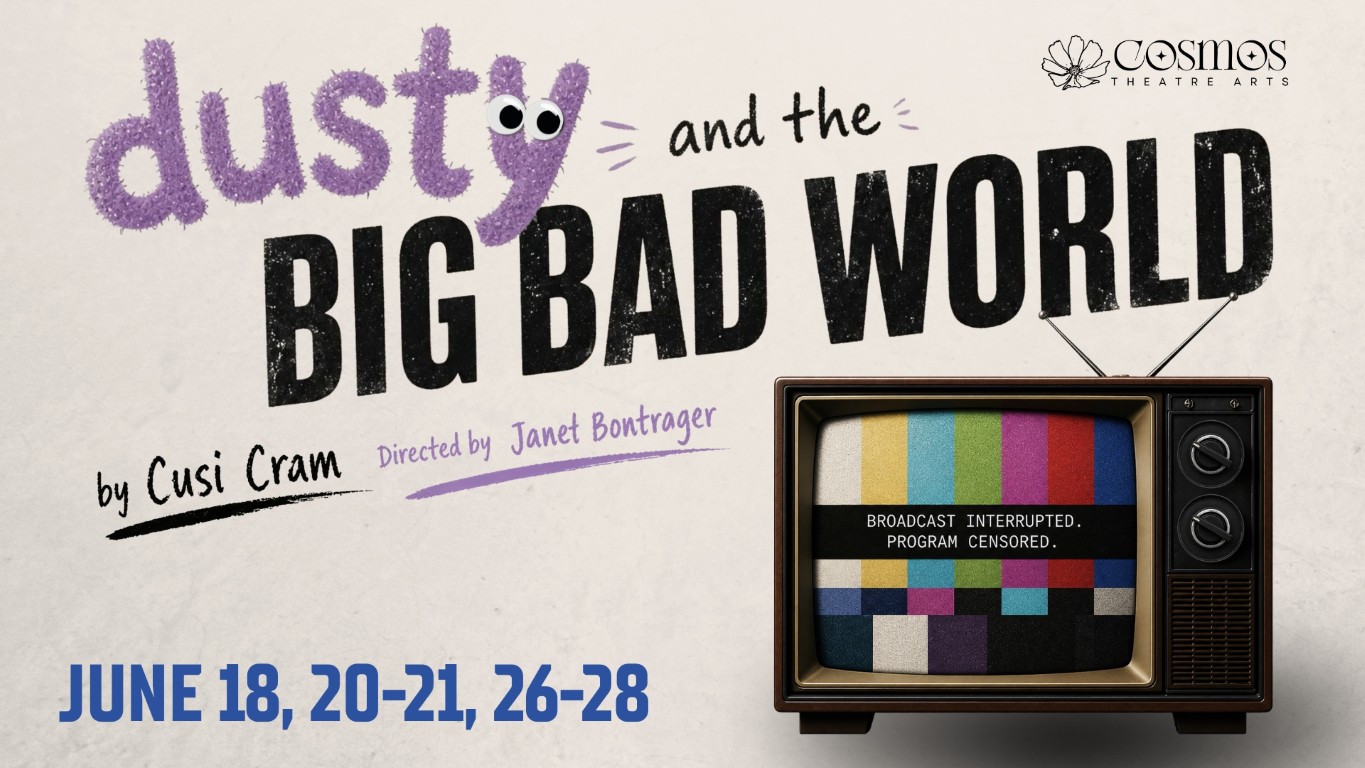
WHAT HAPPENS when a beloved children’s television show collides with the real world?
That question sits at the center of Dusty and the Big Bad World, a bold, fast-moving comedy being presented by Cosmos Theatre Arts. The play follows the creative team behind Dusty, America’s most popular animated PBS children’s program. Warm, cheerful, colorful and seemingly untouchable, Dusty is the kind of show designed to help children see the world with curiosity and kindness.
Then the show chooses a winning family for a special episode.
Out of 15,000 letters submitted by children, the producers select Lizzie Goldberg-Jones and her parents as the featured family. Lizzie’s parents are loving, supportive, and exemplary role models. They also happen to be two men. That single detail, almost incidental within the world of the episode, sets off a political firestorm.
Based on an actual incident from 2005, Dusty and the Big Bad World is a comedy with teeth, provocative, funny, timely and unafraid to ask uncomfortable questions. Director anet Bontrager does not see the play as a one-sided argument. For her, the strength of the script is that it allows every character to be human.
“The audience decides for itself,” Bontrager said. “The play itself does resolve, but it resolves very realistically.”
Bontrager is making her Prescott directorial debut with this production. She brings a deep theatre background to the project, having studied at Purdue University with an emphasis in directing, along with experience in media production. Though she has lived in Prescott since 2012, this is her first time directing locally.
That timing feels right. Dusty and the Big Bad World may be rooted in a 2005 controversy, but its themes feel painfully current. The play looks at what happens when a moment of representation becomes a national argument. It examines the way public opinion can turn art into a battlefield, and how political power can shape what communities are allowed to see.
The real-world inspiration involved an episode connected to the children’s television world of Arthur, where a child’s family included same-sex parents. As Bontrager explained, the family’s identity was not the main point of the episode. The episode was not a lecture, campaign, or agenda. It was simply part of the child’s life.
That is what made the reaction so revealing. The family was not the center of the story, but the presence of same-sex parents became the center of the controversy. What had been written as subtext was treated as a threat.
For Bontrager, that is where the play finds its power. Dusty and the Big Bad World asks why something so ordinary can become so alarming when it challenges what certain people are willing to see.
In the world of the play, that same tension becomes dramatic fuel. The fictional children’s show at the center of the story is built around ideas of diversity, inclusion and imagination. Dusty himself is described as a whimsical creature made up of everything and everyone, able to pull pieces of himself off and go anywhere. In the world of the play, the show’s mission is to help children develop awareness of the wider world.
That mission becomes complicated when the adult world steps in.
The result is a five-character comedy that moves quickly between the producers, the government office, and the child whose family becomes the center of the conflict. It is a small cast, but the world of the play is large. It includes public television, political pressure, religious conviction, progressive outrage, personal privacy, and the complicated ways people justify the decisions they make.
Bontrager was drawn to the play while searching for an LGBTQ-themed work appropriate for Pride month. She did not want something predictable or overly narrow. She wanted a script that was fresh, vibrant, and capable of opening a wider conversation.
“I wanted something that was going to be uplifting and supportive,” she said. “This play brings it into the wider arena.”
The production also fits the mission of Cosmos Theatre Arts. Cosmos Executive Director Lisa Delight describes the company as women-owned and women-run, committed to creating safe, inclusive spaces while also trying work that audiences may not have seen before. “I think what Janet is bringing with Dusty is on brand for Cosmos, trying something new, creating a safe place, truly inclusive in our nature, and doing something on the edge.”
For Bontrager that edge is not about shock for shock’s sake. It is about making room for conversation. The play gives voice to characters on different sides of the cultural and political divide without flattening them into easy stereotypes. Marianne, the government official at the center of the controversy, is not treated as a cartoon villain. Karen, her secretary, admires her strength but questions her decision. Jessica and Nathan, the producers and writers of Dusty, are forced to defend not only an episode of television but the purpose of storytelling itself.
That complexity is part of what attracted Bontrager to the script. The play is funny, but not careless, political but not just political. It’s about systems, families, public pressure, private conviction and the uncomfortable moments when people are asked to examine what they believe.


