
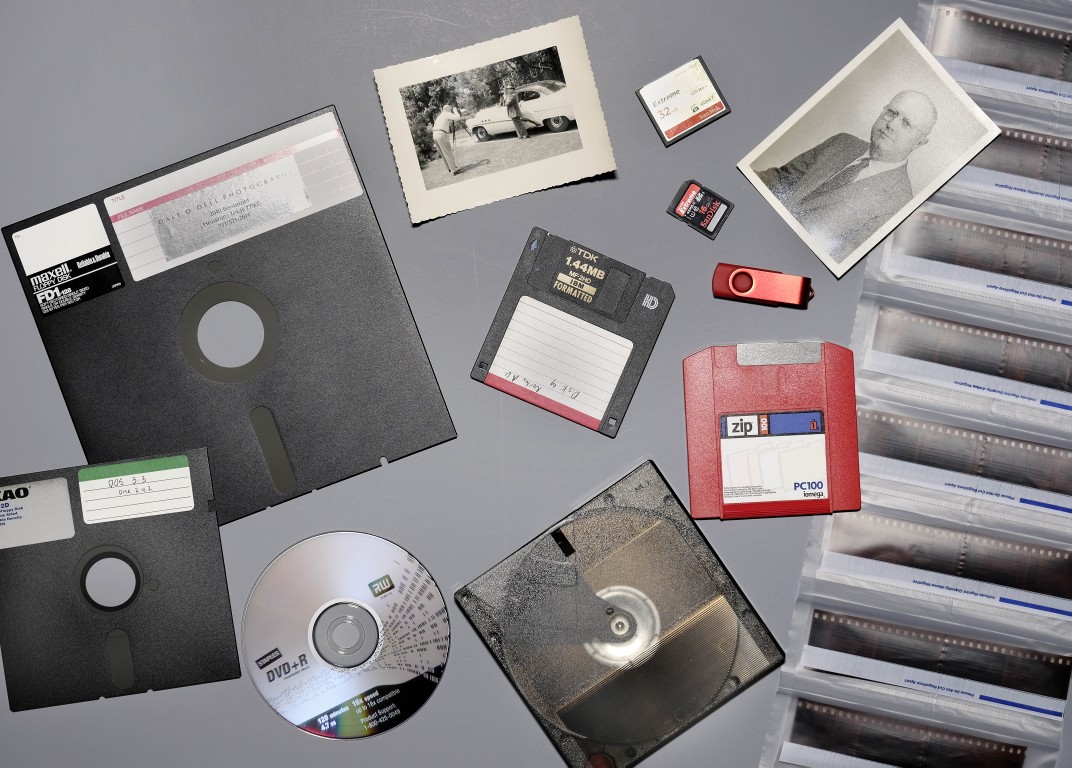
CONSIDER how much of human history is unrecorded and unknown. Homo sapiens emerged between 200,000 and 300,000 years ago, but we’ve only had the written word for 5,000-6,000 years. This means only the last 1-5% of our existence is documented in written text, which isn’t much.
Humanity’s visual record is even more scarce. Invented in 1826, photography became available to the consumer in 1888. Thanks to the original Kodak camera we now have 138 years (about four and a half generations) of visual documentation of average, normal human life, again not very much.
As a result of new technology, specifically the digitization of photography, begun in the 1990s, we very well may lose our photographic record of contemporary daily life. Even though we take more pictures than ever before — over a trillion photos globally each year — fewer and fewer will likely survive into the future.
How can this be? It’s the double-edged sword of ever-changing and ever-improving technology. While I and others could see this coming early on, it really hit home for me personally about 15 years ago.
I was in the attic of my parents’ home, just after my father’s funeral, and my mom would be moving into a nursing home partially funded by the sale of their house, once I got the place cleaned out. I was going through decades of stuff when I found a large collection of photographs, an historic sampling of every kind of 20th-century photographic medium, from color drugstore prints to Polaroids, slides, including Anscochrome, Ektachrome and Kodachrome, old sepia-toned black-and-white prints, even tintypes from the 19th century. The storage conditions were abysmally less than ideal, and the pictures had been cooking in Texas heat and humidity in that attic for over forty years!
All the black-and-white photos I found were in relatively good condition, as were the Kodachrome slides, which were as bright and colorful as the day they were picked up from the photo lab. But the Anscochrome and Ektachrome slides from the ‘60s and ‘70s, along with all the color prints from the drugstores, were faded to near nothingness, because the dyes of the time were unstable.
The pictures still exist and are viewable because they are actual things. They are artifacts, physical representations of the things photographed. They are storable, collectible and possibly valuable. I personally retrieved the photos and have archived and preserved them in optimal conditions for the long term in a cool, dark, low-humidity environment.
The future will be different
In the future, heirs and estate-salespeople won’t find many prints, slides or negatives. They won’t find things, they will find data, stored on a variety of what will then be ‘vintage’ media. Viewing that data will require more time and effort than most will want to expend. This is where the record of the times gets lost. How do we ‘future-proof ’ our digital imagery?
You can’t hold a digital file up to the window like a slide or negative to see what it is. No, viewing a digital image will require electricity, a computer with the right imaging software and whatever hardware it needs to display the images stored in whatever media format.
Who’s to say that in the future there will even be hardware and software available to read things like floppy disks, SyQuest Data Cartridges, Jazz disks, Zip disks, CDs, DVDs, CF cards, SD cards or even thumb drives. I hope my USB hard drives will work in the future, but who knows?
What we’re at risk of losing in the future is the imagery encoded on digital storage media. Three main factors come into play that point to the loss of this part of our personal and public historical records.
First is data corruption. Magnetic and optical storage are not indestructible, and data can be lost over time. Second, it’s highly likely that the hardware/software to read these formats will eventually no longer exist, making the images non-viewable. Third, the person responsible for a photographic archive must give a damn about the photography and have the time to view the images. Most won’t. Many will not have known the deceased, and they’ll be pressed for time, which means the images will be tossed in the trash unseen. Nobody cares about your stupid pictures. A legacy will be lost. History will be undiscovered. The work of the next Vivian Maier won’t be rediscovered in a digital archive.
Occasionally an iPhone photographer will ask me, “I’ve got 400 pictures on my phone, how do I archive them?” They never like my two-word response: “Print them.” No, they don’t want to print; heck, most ‘photographs’ today never get printed. They’re disposable, for one-time-viewing, and exist only in the memory of some device. These photos are never ‘made real’ and printed to become an artifact in our 3D world, no, they only exist as unexpressed, unseen and ephemeral encoded ones and zeros. Unless the photograph is printed, made into a physical thing, viewable without a device, it’s not ‘real.’ Even copyright law states that an image must be “fixed in a tangible medium.”
If this first generation, the 1.0 era of digital photography, isn’t properly preserved, then anyone looking back at this time from the future will find only an image desert. The visual-historical record will be incomplete. A CD or hard drive is not a picture. Some fine-art photography will be preserved because it will be printed, commercial photography might be preserved because it has perceived value, but the average person’s record of their life will be forever lost to time. History will be full of visual holes, deficient. And we just started documenting this stuff only a few generations ago.
It’s highly unlikely that the future will give us another cache of lost Marilyn Monroe-type photos. It’s doubtful that anything of historical significance will be found on some old Zip disk. These things won’t exist, and if they do, they might not be found, or viewed, or work at all. Would anyone dig up the old equipment necessary to view or copy the photos? Would they care? Again, I think it’s improbable.
The surest thing we can do to prevent this loss of historical data is to move the imagery from the virtual world into the real world, by making prints. Yeah, print the ‘good’ or ‘important’ pictures! Good printing will be necessary, not your office printer on cheap copy paper. High quality, using archival pigments or photographic prints, will be necessary if they are meant to last. Prints should be stored archivally, not in a shoe box.
People today seldom consider the future, and most won’t do this. A large quantity of digital files quickly becomes overwhelming to print. As professionals we print as we go, and archive them. Nobody’s going to want to convert, organize and print hundreds of photos from their phone, the job is overwhelming. Our future, consumer-level, visual history will not be as rich as that of the first hundred years of photograpy. Chemical-analog photography started the archive; digital photography may well end it.
If it was important enough to point a camera at, it’s important enough to save. Preserve the moment, print the picture. ‘Future-proof’ your photography!


