



BEHIND the industrial doors of the 6th Street Business Park at 697 6th Street in Prescott, a quiet creative revolution has been unfolding for years. What looks from the outside like a collection of business units and workshops is one of Prescott’s most vibrant artistic communities, a place where sculptors, painters, glass artists, jewelers and makers of every kind create side-by-side.
Known as Art on 6th Street, the group of resident artists and guest artists open their studios to the public every third Saturday 10am–3pm, inviting visitors to step beyond the finished gallery wall and into the working spaces where art is born.
This year’s open-studio events begin with the Start of Summer Party May 15–16, then June 20, July 18, and August 15, closing the season with the annual Holiday Show November 20–21. More than simple art shows, these events are opportunities to meet the artists, hear their stories and witness their creative processes.
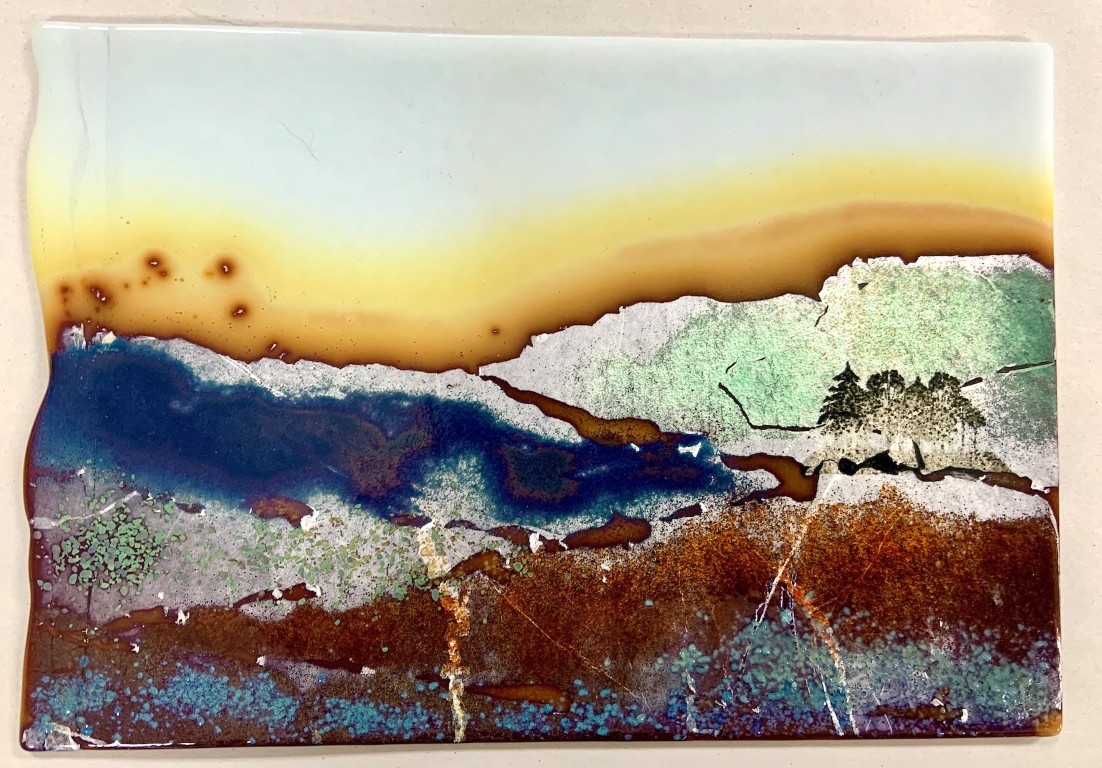
At the heart of this artistic neighborhood is Cindi Shaffer, owner of Astral Glass Studio. Her studio glows with fused and kiln-formed glass, where chemistry and creativity work hand in hand. For Cindi the greatest gift of 6th Street is not just the studio space, it’s the people.
“It’s a sense of community,” she says. “If I’m working on something and I’m not sure where it’s going, I can call someone and say, ‘Come look at this.’ We’re here working alone, but we’re never really alone.”
She describes how visitors often arrive expecting stained glass or blown glass, only to discover an entirely different art form. Her warm-glass process becomes part of the educational experience during open-studio days.
“If I didn’t have this venue, I wouldn’t be able to teach people about what I do,” she explains. “People get to come in and actually understand it.”
6th Street’s first artist
If there is a foundation for Art on 6th Street, it begins with Mary Schulte.
A mosaic artist, sculptor and maker of wearable art and jewelry, Mary was the first artist to move into the business park, nearly 18 years ago. Her public works can be seen throughout Prescott, including murals at the parking garage and library, but her real legacy may be the creative community she helped build.
“I was the only artist here when I started,” she says. “Then Cindi joined me during Studio-Tour season, and from there it just kept growing.”
Mary describes buying her unit as purchasing a blank shell, just walls and possibility. “You build it into what you need. Electricity, heat, bathroom, loft space, it becomes a home for your art.” Every time a unit opens for sale, the artists try to bring in another creative. “The more artists here, the stronger the community becomes.”
Music, painting, and finding the light
Maryhelen Ewing brings a unique creative journey to Art on 6th Street, one that began not with paint, but with music.
Before becoming known for her oil paintings and portrait work, Maryhelen trained at Juilliard as a violinist and violist, later performing with the New York Philharmonic, Metropolitan Opera and in orchestras and studio recordings throughout the city. “I’m a little girl from Tulsa who ended up at Juilliard in New York City,” she says with a laugh. “I survived that.”
For ten years she built a career in professional music before art began calling her in a different direction. While still performing she studied visual art at the Art Students League, often rushing from Lincoln Center to classes and back again. Eventually painting became impossible to ignore.
“What you add as an artist is who you are,” she says. “That’s really what any of us has. Once I got started, I couldn’t help it anymore.” Her preferred medium is oil painting, with landscapes and portraits often taking center stage. “People are my favorite thing to paint, because they’re endlessly fascinating.”
Now sharing studio space with acclaimed Hopi artist Filmer Kewanyama, Maryhelen says the light inside the studio is part of the magic.
“It’s a beautiful space. The light in there is incredible. I’ve been really lucky to have it.”
Color, abstraction, and community

Mary Hayes brings bold color and expressive abstraction through her work in oils, acrylics and printmaking. Her paintings often begin with landscape foundations, but move into abstraction, allowing emotion and interpretation to take over.
She recalls one particular painting inspired by rapid development across Arizona, a black-and-white work with a single house remaining in the corner. One viewer found it depressing, while another called it the most beautiful painting in the room. “That’s art,” Mary says. “Someone always has an eye for something.”
For Mary, the studio space is both practical and deeply personal. “With oil paints, you need ventilation. This space gives you that. More important, it gives you community. You’re making art by yourself, but you’re never really alone.”
Her eye for composition also helps the other artists. Paul Landis tells the story of Mary studying one of his wall-mounted quietly suggesting he change one color. “I stared at it for a month,” Paul says, “and when I finally made the change, she was absolutely right.” That kind of artistic trust is what defines this place.
Motion, balance, and the art of air
For Paul Landis, movement itself is the medium. Known for his elegant mobiles and kinetic wall sculptures, Paul creates hanging works that shift with the slightest air current, changing not only their shapes but the entire energy of the room. “Balance is my art, and motion is my medium,” he says.
His work is influenced by the legacy of Alexander Calder, but Paul has developed a voice entirely his own. His large studio space, with 14-foot ceilings, allows him to hang and test pieces in ways few artists can.
“I can show people exactly how a mobile will look at eight feet, ten feet, or twelve feet. The space lets me create and present the work the way it needs to be seen.”
His favorite part of every installation is “the shadows,” he smiles. “I sell the mobile, but the shadows are free.”
Steel, fire, and collaboration
Metal sculptor Ron Miller brings engineering, welding and a practical sense of problem-solving into the artistic mix.
His work ranges from kinetic sculptures and artistic garden pieces to birdbaths, wind spinners and large sculptural forms that often combine steel and clay. “It’s really cohesive here,” Ron says. “We came together to sell our art and hopefully make enough to keep the studios going, but more than that, we collaborate.”
As the group’s unofficial fixer, Ron is often the one repairing broken equipment, welding supports or helping artists solve structural challenges. “Cindi has made glass for my sculptures, and I’ve made metal holders for hers. We all help each other.” It is less competition and more conversation through materials.
Dancing with stone
At nearly ninety years old, Arliss Newcomb continues to carve stone with the same passion she has carried for nearly five decades. Her sculptures begin not with a design, but with a stone.
“I like to go to a quarry and pick out a natural stone,” she says. “Sometimes I’ll keep a piece for twenty years before it tells me what it wants to be.”
She calls the sculpting process a dance. “I can be working and not notice anything else around me. I’m focused completely on that stone.”
Her work proves that creativity has no age limit, only momentum. “If you stop learning, you might as well give up. Learning is what keeps you young.”
An extended creative family
The strength of Art on 6th Street reaches beyond the artists present in the room that day. The creative family also includes respected Hopi artist Filmer Kewanyama, whose sculpture and cultural presentations continue to draw attention throughout Arizona.
It includes Leslee Oaks, whose steel sculpture and found-object work bring new life to reclaimed materials, along with Hilarie Strong, a jeweler whose detailed craftsmanship adds another layer of artistry to the group.
Textile artist Joan Knight contributes both fabric-based work and a spirit of collaboration, while Nancy McLaughlin adds to the diversity and evolving voice of the 6th Street community.
Each artist strengthens the experience for visitors and for one another. As Arliss says, “You don’t get critique here. You get support.” That may be the true masterpiece of Art on 6th Street.
This summer, follow the yellow signs, walk through every studio, and meet the artists who’ve turned an industrial business park into one of Prescott’s most inspiring creative destinations.


